Posts

Showing posts with the label apt

Greg Rattray Invented the Term Advanced Persistent Threat

Image
  I was so pleased to read this Tweet yesterday from Greg Rattray: " Back in 2007, I coined the term “Advanced Persistent Threat” to characterize emerging adversaries that we needed to work with the defense industrial base to deal with ... Since then both the APT term and the nature of our adversaries have evolved. What hasn’t changed is that in cyberspace, advanced attackers will persistently go after targets with assets they want, no matter the strength of defenses." Background First, some background. Who is Greg Rattray? First, you could call him Colonel or Doctor. I will use Col as that was the last title I used with him, although these days when we chat I call him Greg.  Col Rattray served 21 years in the Air Force and also earned his PhD in international security from Tufts University. His thesis formed the content for his 2001 book Strategic Warfare in Cyberspace , which I reviewed in 2002 and rated 4 stars . (Ouch -- I was a bit stingy with the stars back then. I...

Forcing the Adversary to Pursue Insider Theft

Image
Jack Crook  pointed me toward a story by  Christopher Burgess  about intellectual property theft by "Hongjin Tan, a 35 year old Chinese national and U.S. legal permanent resident... [who] was arrested on December 20 and charged with theft of trade secrets. Tan is alleged to have stolen the trade secrets from his employer, a U.S. petroleum company," according to the criminal complaint filed by the US DoJ. Tan's former employer and the FBI allege that Tan "downloaded restricted files to a personal thumb drive." I could not tell from the complaint if Tan downloaded the files at work or at home, but the thumb drive ended up at Tan's home. His employer asked Tan to bring it to their office, which Tan did. However, he had deleted all the files from the drive. Tan's employer recovered the files using commercially available forensic software. This incident, by definition, involves an "insider threat." Tan was an employee who appears to have cop...

Bejtlich on the APT1 Report: No Hack Back

Image
Before reading the rest of this post, I suggest reading Mandiant/FireEye's statement Doing Our Part -- Without Hacking Back . I would like to add my own color to this situation. First, at no time when I worked for Mandiant or FireEye, or afterwards, was there ever a notion that we would hack into adversary systems. During my six year tenure, we were publicly and privately a "no hack back" company. I never heard anyone talk about hack back operations. No one ever intimated we had imagery of APT1 actors taken with their own laptop cameras. No one even said that would be a good idea. Second, I would never have testified or written, repeatedly, about our company's stance on not hacking back if I knew we secretly did otherwise. I have quit jobs because I had fundamental disagreements with company policy or practice. I worked for Mandiant from 2011 through the end of 2013, when FireEye acquired Mandiant, and stayed until last year (2017). I never considered quitting...

Remembering When APT Became Public

Image
Last week I Tweeted the following on the 8th anniversary of Google's blog post about its compromise by Chinese threat actors : This intrusion made the term APT mainstream. I was the first to associate it with Aurora, in this post  https://taosecurity.blogspot.com/2010/01/google-v-china.html My first APT post was a careful reference in 2007, when we all feared being accused of "leaking classified" re China:  https://taosecurity.blogspot.com/2007/10/air-force-cyberspace-report.html I should have added the term "publicly" to my original Tweet. There were consultants with years of APT experience involved in the Google incident response, and they recognized the work of APT17 at that company and others. Those consultants honored their NDAs and have stayed quiet. I wrote my original Tweet as a reminder that "APT" was not a popular, recognized term until the Google announcement on 12 January 2010. In my Google v China blog post  I wrote: Welco...

An Irrelevant Thesis

Image
This week The Diplomat published an article by Dr Greg Austin titled  What the US Gets Wrong About Chinese Cyberespionage . The subtitle teases the thesis: "Is it government policy in China to pass on commercial secrets obtained via cyberespionage to civil sector firms?" As you might expect (because it prompted me to write this post), the author's answer is "no." The following contains the argument: "Chinese actors may be particularly adept in certain stages of economic espionage, but it is almost certainly not Chinese government policy to allow the transfer of trade secrets collected by highly classified intelligence sources to its civil sector firms for non-military technologies on a wide-spread basis . A U.S. influencing strategy toward China premised on the claim that this is China’s policy would appear to be ill-advised based on the evidence introduced so far by the United States in the public domain." (emphasis added) I find it interest...

Mandiant APT1 Report: 25 Best Commentaries of the Last 12 Days

Image
Two weeks ago today our team at Mandiant was feverishly preparing the release of our APT1 report . In the twelve days that followed publication on the evening of Monday the 18th, I've been very pleased by the amount of constructive commentary and related research published online. In this post I'd like to list those contributions that I believe merit attention, in the event you missed them the first time around. These sorts of posts are examples of what the security community can do to advance our collective capability to counter digital threats. Please note I avoided mass media accounts, interviews with Mandiant team members, and most general commentary. They are listed in no particular order. Seth Hall (Bro): Watching for the APT1 Intelligence Jason Wood (SecureIdeas): Reading the Mandiant APT1 Report Chris Sanders: Making the Mandiant APT1 Report Actionable Symantec: APT1: Q&A on Attacks by the Comment Crew Tekdefense (NoVA Infosec): MASTIFF Analysis of APT...

To Be Hacked or Not To Be Hacked?

Image
People often ask me how to tell if they might be victims of state-serving adversaries . As I've written before , I don't advocate the position that "everyone is hacked." How then can an organization make informed decisions about their risk profile? A unique aspect of Chinese targeted threat operations is their tendency to telegraph their intentions. They frequently publish the industry types they intend to target, so it pays to read these announcements. Adam Segal Tweeted a link to a Xinhua story titled China aims to become world technological power by 2049 . The following excerpts caught my attention: China aims to become a world technological power by 2049 and strives to be a leading nation in innovation and scientific development, according to a government document released on Sunday. The document, released by the Communist Party of China Central Committee and the State Council, or the Cabinet, namely opinions on "deepening technological system reform...

The Toughest Question in Digital Security

Image
The toughest question in digital security is "who cares?" The recent Tweet by hogfly (@4n6ir) made me ponder this question. He points to an Aviation Week story by David Fulghum, Bill Sweetman, and Amy Butler titled China's Role In JSF's Spiraling Costs . It says in part: How much of the F-35 Joint Strike Fighter’s spiraling cost in recent years can be traced to China’s cybertheft of technology and the subsequent need to reduce the fifth-generation aircraft’s vulnerability to detection and electronic attack? That is a central question that budget planners are asking, and their queries appear to have validity. Moreover, senior Pentagon and industry officials say other classified weapon programs are suffering from the same problem. Before the intrusions were discovered nearly three years ago, Chinese hackers actually sat in on what were supposed to have been secure, online program-progress conferences, the officials say. The full extent of the connection is stil...

National Public Radio Talks Chinese Digital Espionage

Image
When an organization like National Public Radio devotes an eleven minute segment to Chinese digital espionage, even the doubters have to realize something is happening. Rachel Martin's story China's Cyber Threat A High-Stakes Spy Game is excellent and well worth your listening ( .mp3 ) or reading time. Rachel interviews three sources: Ken Lieberthal of the Brookings Institution, Congressman Mike Rogers (chairman of the House Intelligence Committee), and James Lewis from the Center for Strategic and International Studies. If you listen to the report you'll hear James Lewis mention "a famous letter from three Chinese scientists to Deng Xiaoping in March of 1986 that says we're falling behind the Americans. We're never going to catch up unless we make a huge investment in science and technology." James is referring to the so-called 863 Program (Wikipedia). You can also read directly from the Chinese government itself here , e.g.: In 1986, to meet the gl...

Interview with One of My Three Wise Men

Image
Tony Sager from the NSA is one of my Three Wise Men. (Dan Geer and Ross Anderson are the other two.) Eric Parizo from SearchSecurity.com interviewed Tony this week and posted the video online. Tony notes that the escalation in threat activity during the last few years is real. He is in a position to know, given he has worked at NSA since the 1970s. Tony says the threat activity is getting people's attention now, especially at more senior levels of the government and industry. Now targeted organizations are thinking beyond the question "does this affect my company" to "does this affect my industry?" Tony explains that a generational effect may account for the change in awareness. More senior leaders grew up with technology, so they know how to think about it. There is also more public reporting on serious security incidents today. My favorite quote was: "If you're not a little concerned, you haven't been paying attention." Since Tony is...

C-SPAN Posts Video of Tuesday Hearing

Image
You can now access video of Tuesday's House Select Committee on Intelligence Hearing on Cybersecurity at C-SPAN . Some people are already asking "what's new" about this. For me, what's new is that the chairman of the HPSCI is pointing his finger straight at the threat, and letting the world know in an open hearing that the adversary's actions are unacceptable and will not be tolerated. This is exactly the sort of attention and action that the threat deserves and I applaud the Chairman and HPSCI for pursuing this course. Remember that the HPSCI is more likely to hold closed hearings than open hearings due to the nature of its classified intelligence oversight work. By conducting an open hearing, Chairman Rogers wanted to send a clear message to victims, the public, and the adversary. Tweet

Bejtlich Cited in Chinese Article on APT

Image
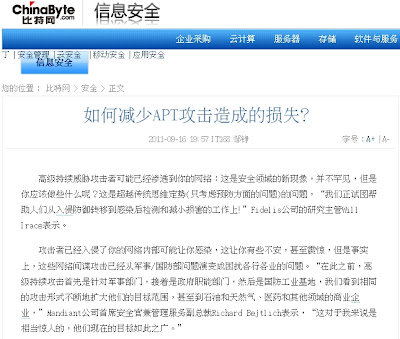
I found it ironic to see the names Richard Bejtlich and MANDIANT appearing in the article How to reduce the losses caused by APT attack? The reason this is funny is that the article appears in a Chinese-language story, published by a site operating in Beijing! You can read the Google Translation if you can't read the original. According to Tianji Media Group : Established in January 1997, ChinaByte was the first IT news website in China. So, welcome to the APT coverage! Tweet

Classic Chinese Defensive Propaganda

Image
Thanks to the sharp eye of a colleague from a mailing list, I learned of the article Is China Really Cyberdragon? in the English-language China Daily newspaper. The article is by Tang Lan, deputy director of the Institute of Information and Social Development Studies, China Institutes of Contemporary International Relations (a state-directed research institute). His writing displays all of the class elements of what I call Chinese defensive propaganda, in this case specifically addressing APT intrusions. I'll cite a few examples so you know what I mean. Hacking poses a threat to both China and Western countries and politicizing the problem will be detrimental to all. The beginning of the article introduces the reader to the concept that China is just as much a victim of hacking as the West. This is the first invocation of "the victim card," which is a constant aspect of Chinese self-identity and international relations. Tang Lan then dismisses accusations that the C...

Expect to Hear "IDS Is Dead" (Again)

Image
Do you remember when IDS was dead , and supposed to be replaced by "thought-leading firewalls" by 2005? Well, that prediction died pretty quickly. However, I expect to hear it again after reading DIB cybersecurity pilot has stopped 'hundreds' of intrusions, says Lynn : About 20 companies participate in the Defense Department's 90-day pilot for an active network defense capability for the defense industrial base analogous to the Homeland Security Department's Einstein 3 effort, said Deputy Defense Secretary William Lynn. During an address to the 2011 DISA Customer and Industry Forum in Baltimore, Md., Lynn said the sharing of malicious code signatures gathered through intelligence efforts to pilot participants has already stopped "hundreds of intrusions." Lynn also laid blame for intrusions into military and defense industrial base networks on "foreign intelligence services," stating that they have stolen military plans, weapons...

Bejtlich Leading Session at IANS

Image
The IANS group just posted their fall forum announcement . It states I will be leading a session on the APT at their event in Boston on 20 September 2011. Kicking off the morning will be Richard’s session on “Mitigating the Advanced Persistent Threat.” IANS continually hears from our clients that APT and cyber crime is a constant, nagging concern (if not for their own company… yet, then because of headline news read by company executives), and it is the CISO’s job to deal with real, perceived, and impending APT issues. Thus, during his session Richard will provide advice and real-life use cases on what he’s seen, what’s worked, what doesn’t, and what CISOs can do to deal with APTs at their own organizations. Following the short presentation portion of the session, CISOs will collectively discuss 1) How to keep up with industry-specific threats; 2) Tactics and techniques to detect and mitigate the APT; and 3) The real implications of APT incidents This should be a great ...

Bejtlich Keynote at Hawaiian Telcom Conference

Image
Thanks to Hawaiian Telcom I will be speaking at their 2011 Security Conference in Honolulu on 7 September 2011. My topic is "Putting the A, P, and T into the Advanced Persistent Threat:" Advanced Persistent Threat, or APT, is a controversial term. Just what qualifies as the APT? Who invented this term? Is it a marketing vehicle or is there a method to its use? In this keynote, Mandiant CSO Richard Bejtlich will explain the history of the APT, and what makes it Advanced, Persistent, and a Threat. He will discuss the concepts of "fighting through" an intrusion and "operating in a contested network," approaches to dealing with the APT that work in the real world. My colleague and friend Kris Harms will also attend, presenting "Network Security FTW." We hope to see you there! And no, Jeremiah Grossman, we will not be joining you to fight MMA-style. Well, maybe Harms will. Tweet

Why Business Methods Are as Important as IP to China

Image
Courtesy of China Defense Blog , I just read a fascinating (if you like aircraft) report on China's capability to natively produce jet engines produced by China SignPost titled Jet Engine Development in China: Indigenous high-performance turbofans are a final step toward fully independent fighter production (pdf). It's common to see open source reports describing how the APT seeks intellectual property (IP), which many people read as plans, designs, and related mechanical and scientific information. What some miss, however, is that China needs business know-how as well as technical know-how in order to achieve its economic and security goals. The report includes examples of this: What China must achieve, however, is a methodology akin to Six Sigma or Total Quality Management (TQM) to ensure quality control and sufficient organizational honesty to ensure that actual problems are reported and that figures are not doctored. Otherwise, standardization and integration may be the...

APT Drives Up Bomber Cost

Image
Bill Sweetman wrote a good article on the new Air Force bomber program titled USAF Bomber Gets Tight Numbers . I found the following paragraph interesting: One factor will drive up the cost of the bomber’s R&D: its status as a SAP [Special Access Program]. SAP status — whether the program is an acknowledged SAP, as the bomber is likely to be, or completely black — incurs large costs. All personnel have to be vetted before they are read into the program. Information within the program is compartmentalized, reducing efficiency. SAP status has been estimated to add 20% to a program’s cost . Security for SAP isn't cheap! Sweetman elaborates: The most likely reason for this measure is the sensitivity of ELO [extreme low-observable] technology, combined with the fact that the U.S. is the target of what may be the most extensive and successful espionage program in history — China’s Advanced Persistent Threat. How much is the new bomber supposed to cost? The magic numbers for the bo...

Aviation Week on China's Military Capabilities

Image
Today Richard D. Fisher, Jr. and Bill Sweetman published an online article for Aviation Week titled Sizing Up China's Military Capabilities . Of interest to my readers might be the following: It is no secret that long-term U.S. Air Force and Navy planning is focused on China... A decade ago, many U.S. analysts were unimpressed by the People’s Liberation Army (PLA)... By 2011, such hubris has given way to palpable concern... The elements of this capability include: Information attack. In the mid-2000s, U.S. intelligence agencies identified the Advanced Persistent Threat (APT) , a pattern of cyberespionage largely traceable to China and aimed mainly at the U.S. defense industry and armed forces... I really like to see organizations that are not selling digital security, but who are still defense experts, discuss APT! Some of you probably think Aviation Week is part of the "create a new bogey man" strategy as we draw down forces in Iraq. Surely APT is just "yellow pe...

Initial Thoughts on RSA "APT" Announcement

Image
Today RSA's Art Coviello announced the following: Recently, our security systems identified an extremely sophisticated cyber attack in progress being mounted against RSA... Our investigation has led us to believe that the attack is in the category of an Advanced Persistent Threat (APT). Our investigation also revealed that the attack resulted in certain information being extracted from RSA's systems. Some of that information is specifically related to RSA's SecurID two-factor authentication products. While at this time we are confident that the information extracted does not enable a successful direct attack on any of our RSA SecurID customers, this information could potentially be used to reduce the effectiveness of a current two-factor authentication implementation as part of a broader attack... This is one of the problems with debates over terminology. If we all accepted the actual definition of APT as created by the Air Force in 2006, we would know what Mr Coviello is...