Posts

Showing posts with the label law

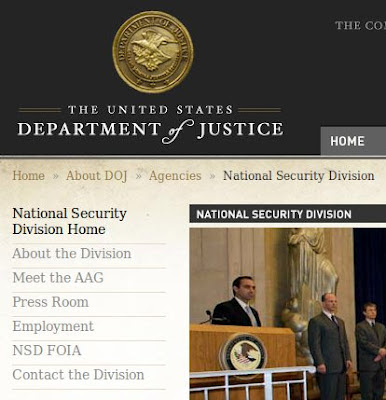
DOJ National Security Division Pursuing Cyber Espionage
Image
I just read Justice Department trains prosecutors to combat cyber espionage by Sari Horowitz, writing for the Washington Post. The article makes several interesting points: Confronting a growing threat to national security, the Justice Department has begun training hundreds of prosecutors to combat and prosecute cyber espionage and related crimes, according to senior department officials. The new training is part of a major overhaul following an internal review that pinpointed gaps in the department’s ability to identify and respond to potential terrorist attacks over the Internet and to the rapidly growing crime of cyber espionage, the officials said, describing it for the first time. In recent weeks, Justice has begun training more than 300 lawyers in Washington and nearly 100 more across the county in the legal and technical skills needed to confront the increase in cyber threats to national security... Under the reorganization, teams of specialized lawyers within NSD in Wa...

Tort Law on Negligence

Image
If any lawyers want to contribute to this, please do. In my post Shodan: Another Step Towards Intrusion as a Service , some comments claim "negligence" as a reason why intruders aren't really to blame. I thought I would share this case from Tort Law , page 63: In Stansbie v Troman [1948] 2 All ER 48 the claimant, a householder, employed the defendant, a painter. The claimant had to be absent from his house for a while and he left the defendant working there alone. Later, the defendant went out for two hours leaving the front door unlocked. He had been warned by the claimant to lock the door whenever he left the house. While the house was empty someone entered it by the unlocked front door and stole some of the claimant's posessions. The defendant was held liable for the claimant's loss for, although the criminal action of a third party was involved, the possibility of theft from an unlocked house was one which should have occurred to the defendant. So, the ...

Be the Caveman Lawyer

Image
A few weeks ago I recommended security people to at least Be the Caveman and perform basic adversary simulation / red teaming. Now I read Australia's top enterprises hit by laymen hackers in less than 24 hours : A penetration test of 200 of Australia's largest enterprises has found severe network security flaws in 79 percent of those surveyed. The tests, undertaken by University of Technology Sydney (UTS), saw 25 non-IT students breach security infrastructure and gain root or administration level access within the networks of Australia's largest companies, using hacking tools freely available on the Internet. The students - predominately law practitioners - were given 24 hours to breach security infrastructure on each site and were able to access customer financial details, including confidential insurance information, on multiple occasions. High-level business executives from the companies surveyed, rather than IT staff, were informed of the tests so the "day-to-d...

More on Enterprise Data Centralization

I'd like to respond to a few comments to my post Enterprise Data Centralization . The first paragraph includes the following: However, I haven't written about a natural complement to thin client computing -- enterprise data centralization. In this world, the thin client is merely a window to a centralized data store (sufficiently implemented according to business continuity processes and methods like redundancy, etc.) . The bolded part is my answer to those who think my "centralization" plan means building the Mother of All Storage Servers/Networks. Please. Do you think I would really advocate that? The bolded part is my shorthand for saying I do NOT mean to build the Mother of All Storage Servers/Networks. Instead, I envision something similar to the way Google operates. One of you used Google as an example of data decentralization. Sure, the data is decentralized at the level of bits on media, but it's exceptionally centralized where it matters -- the user...

CALEA Mania

CALEA is the Communications Assistance for Law Enforcement Act . I wrote about CALEA three years ago in Excellent Coverage of Wiretapping : CALEA requires telecommunications carriers to allow law enforcement "to intercept, to the exclusion of any other communications, all wire and electronic communications carried by the carrier" and "to access call-identifying information," among other powers. A lot has happened since then. Basically, all facilities-based broadband access providers and interconnected VoIP service providers must be CALEA-compliant by 14 May 2007. This means a lot of companies, of all sizes, are scrambling to deploy processes and tools to collect information in accordance with the law, as well as filing the right reports with the FCC . If you're affected by CALEA I don't think you'll learn much from this post. However, those who do not work for ISPs might like to know a little bit about what is happening. (Note: I am not perso...

Monitoring and Investigation Lessons

Thanks to 27B Stroke 6 I learned that cybercriminal Jerome Heckenkamp (sorry Kevin, he's no "superhacker") will stay a criminal. The U.S. 9th Circuit Court of Appeals refused to overturn Heckenkamp's conviction. According to this DoJ announcement : Mr. Heckenkamp's sentence results from his guilty pleas in January 2004 to two counts of gaining unauthorized access into a computer and recklessly causing damage, in violation of 18 U.S.C. §§ 1030(a)(5)(B). In pleading guilty, Mr. Heckenkamp admitted that he gained unauthorized access to eBay computers during February and March 1999. Using this unauthorized access, Mr. Heckenkamp admitted that he defaced an eBay Web page using the name "MagicFX," and that he installed "trojan" computer programs - or programs containing malicious code masked inside apparently harmless programs - on the eBay computers that secretly captured usernames and passwords that Mr. Heckenkamp later used to gain unauthorize...

Full Content Monitoring as a Wiretap

I received the following question today: When installing Sguil, what legal battles have you fought/won about full packet capture and its vulnerability to open records requests from outside parties? I am getting concerns, from various management, regarding the legal ramifications of the installation of a system similar to Sguil in the state government arena. Do you have any advice for easing their worries? I know how important full data capture is to investigating incidents, and I consider it of paramount importance to the security of our state that we do so. Are there any legal precedents that can be cited? Before I say anything else it is important to realize I am not a lawyer, I don't play one on YouTube, and I recommend you consult your lawyer rather than listen to anything I might say. With that out of the way, I have written about wiretaps a few times before. Let me get these generic wiretapping issues out of the way before addressing the question specifically. Understand...

When Lawsuits Attack

I haven't said anything about the intrusions affecting TJX until now because I haven't felt the need to contribute to this company's woes. Today I read TJX Faces Suit from Shareholder : The Arkansas Carpenters Pension Fund owns 4,500 shares of TJX stock, and TJX denied its request to access documents outlining the company's IT security measures and its response to the data breach. The shareholder filed the lawsuit in Delaware's Court of Chancery Monday afternoon under a law permitting shareholders to sue for access to corporate documents in certain cases, The Associated Press reported. The pension fund wants the records to see whether TJX's board has been doing its job in overseeing the company's handling of customer data, the news agency said. Imagine having your security measures and incident response procedures laid bare for everyone to see. (It's possible there might not be anything to review!) How would your policies and procedures fare? The fol...

When Laws Aren't Enough

Image
CIO Magazine published The Global State of Information Security 2006 . The story contained what I consider to be some fairly disappointing results. Complacency, it seems, abounds. A large proportion of security execs admitted they're not in compliance with regulations that specifically dictate security measures their organization must undertake or risk stiff sanctions, up to and including prison time for executives. Some of these regulations—such as California's security breach law, the Health Insurance Portability and Accountability Act (HIPAA), and non-U.S. laws such as the European Union Data Privacy Directive—have been around for years. .. The information security discipline still suffers from the fundamental problem of making a business value case for security. Security is still viewed and calculated as a cost, not as something that could add strategic value and therefore translate into revenue or even savings. (emphasis added) No one spends money on insurance because ...

Signs of Desperation from Duronio Defense Team

It sounds to me like the Duronio defense team has nothing left in its tank, so it's attacking Keith Jones directly. The latest reporting, UBS Trial: Defense Suggests Witness Altered Evidence , shows how ridiculous the defense team sounds: "So when you talked about putting pieces of the puzzle together, you were missing three-quarters of the pieces for the [central file server] alone?"" [defense attorney] Adams asked. "The puzzle pieces I had to put together formed the picture I needed," Jones replied. "If the puzzle was of a boat, then I had enough pieces to form the picture of the boat." Adams countered, "But you might not see all the other boats around it." Jones replied, "But the second boat won't get rid of the first boat. It's simple mathematics that when you add data, you don't subtract data. There was nothing in that data set that could remove the data I already had." It sounds like Keith has more testifyin...

Cluelessness at Harvard Law Review

Articles like Immunizing the Internet, or: How I Learned To Stop Worrying and Love the Worm (.pdf) in the June 2006 (link will work shortly) Harvard Law Review make me embarrassed to be a Harvard graduate . This is the central argument: [C]omputer networks, particularly the Internet, can be thought of as having immune systems that are strengthened by certain attacks. Exploitation of security holes prompts users and vendors to close those holes, vendors to emphasize security in system development, and users to adopt improved security practices. This constant strengthening of security reduces the likelihood of a catastrophic attack -- one that would threaten national or even global security. In essence, certain cybercrime can create more benefits than costs, and cybercrime policy should take this concept into account. Apparently Harvard lawyers do not take economics classes. If they did (or paid attention) they would know of Frédéric Bastiat's parable of the broken window . The...

A Real Logic Bomb

Image
Logic bomb is a term often used in the media, despite the fact that almost all reporters (there are notable exceptions ) have no clue what it means. Well, now we can look at a real one, thanks to forensics work by Keith Jones . He found a real logic bomb while doing forensics on the United States v. Duronio case. I worked the very beginning of this case while Keith and I were both at Foundstone. My small part involved trying to figure out how to restore images of AIX machines from tape. I even bought an AIX box on eBay for experimentation. You can read about Keith's testimony in this Information Week article. This is the "logic bomb" Keith recovered: One of the neat aspects of this case is its age: over four years. The media and elsewhere are abuzz with stories of "insider threats," but this has been a problem for a very long time. Congratulations to Keith for testifying on such an important case. If the jury has a clue, the defendant doesn't h...

Monitoring the Wrong Places

I am obviously a proponent of network security monitoring, but I am also a strong believer in privacy. The sort of attitude demonstrated in this article disturbs me greatly: Houston's police chief on Wednesday proposed placing surveillance cameras in apartment complexes, downtown streets, shopping malls and even private homes to fight crime during a shortage of police officers. "I know a lot of people are concerned about Big Brother, but my response to that is, if you are not doing anything wrong, why should you worry about it?" Chief Harold Hurtt told reporters Wednesday at a regular briefing. Sure Chief, why don't you lead by example and install cameras in your home . You're not doing anything wrong, are you? Building permits should require malls and large apartment complexes to install surveillance cameras, Hurtt said. And if a homeowner requires repeated police response, it is reasonable to require camera surveillance of the property, he said... So, the pow...

Two Great Wiretapping Articles

Given the recent coverage of wiretapping in the mainstream media, I thought I would point out two excellent articles in the latest issue of IEEE Security & Privacy Magazine . Thankfully, both are available online: Signaling Vulnerabilities in Wiretapping Systems by Micah Sherr, Eric Cronin, Sandy Clark and Matt Blaze Security, Wiretapping, and the Internet by Susan Landau Both concentrate on technical issues of wiretapping. The first concentrates on how to tap a physical line or switch, and ways to defeat those taps. The second describes why incorporating wiretap features into VoIP is a bad idea. Each article discusses relevant laws.

Congratulations to Feds

I'd like to congratulate the United States Attorney's Office, Central District of California for indicting a bot net controller. According to the press release and the indictment (.pdf), up to 400,000 victims were compromised. You can track the progress of this case through the Post Indictment Arraignment Calendar . This is exactly the sort of work that needs to be done. Security professionals cannot win against intruders if only the "vulnerability" variable of the risk equation is addressed. We need law enforcement to reduce the "threat" variable as well. The suspect in this case is a 20-year-old living in California. This is the sort of perpetrator who can be deterred, unlike a foreign intelligence agent or member of organized crime. The more bot net operators who are put in jail, the fewer lower-end threats we will need to stop.

Mark Rasch on Cabellas Case

Last month I wrote on the Caballes drug case. On Tuesday the former head of the US DoJ's computer crimes squad wrote Of Dog Sniffs and Packet Sniffs . In his article Mark Rasch says: "[T]he search by the dog into, effectively, the entire contents of a closed container inside a locked trunk, without probable cause, was 'reasonable' even though the driver and society would consider the closed container 'private' because the search only revealed criminal conduct. The same reasoning could easily apply to an expanded use of packet sniffers for law enforcement." Since Rasch is a Senior Vice President and the Chief Security Counsel (i.e., a lawyer) at Solutionary Inc., he may be on to something. The comments on Mark's article by those not trained as lawyers are in some cases amusing. He responds to several of them.

US Supreme Court Rules on Real False Positives

Last year when US Senator Ted Kennedy was detained for being on a no-fly list , I discussed his plight in relation to intrusion detection system "false positives." If an IDS is operating correctly, every alert it sees is the result of an action it was programmed to take. In other words, when a functioning IDS sees "cmd.exe", it reports seeing "cmd.exe". It doesn't matter if the appearance of "cmd.exe" on the wire is not part of an actual intrusion; a rule to alert on "cmd.exe" does not cause "false positives" if the IDS reports seeing "cmd.exe". A real false positive involves the IDS reporting "cmd.exe" when no such content passed on the wire. Therefore, there are no such things as false positives. Blame the signature writer or IDS developer, not the IDS. Let's move from the realm of IDS false positives to the land of canine false positives. Yesterday the US Supreme Court issued its opinio...

Prof Kerr on KeyKatcher Case

I always enjoy reading Professor Orin Kerr's Computer Crime Case Updates . This week he comments on the dismissed wiretapping case mentioned by SecurityFocus.com and Slashdot . Although some commentary from the likes of Slashdot is helpful, I prefer reading the opinions of a Harvard Law graduate and former Supreme Court clerk . The case is simple: does use of a keystroke logger constitute a wiretap? The judge in the case said no. I agree with Prof Kerr's assessment that the opinion is wrong. If someone listens in on a phone between the handset and the base unit, it's still a wiretap. It's no different if someone collects keystrokes using a device between a keyboard and CPU. However, I disagree with Prof Kerr's reasoning concerning interstate commerce. Plenty of judges disagree with me, but I don't think connecting to the Internet makes a system automatically engaged in "interstate commerce." I think the use of the so-called Interstate Com...

Holding Owners of Compromised Computers Responsible

I've heard several people refer to legal activity in Texas, where victims of intrusions were being sued when the original victim's systems attacked third parties. This happened in 2001, when systems at Exodus were allegedly compromised and used to attack Web-hosting company C.I. Host . Marc Zwillinger mentioned this is this webcast , saying the suit was moved to Federal court and then settled out of court. His slides included this scan of the indictment. From this article : JUST BEFORE 8 A.M. ON FEB. 1, 2001, C.I. Host, a Web-hosting company with 90,000 customers, was hit with a crippling denial-of-service attack. By the end of the day, after outage complaints from what CEO Christopher Faulkner described as "countless" customers, the Fort Worth, Texas-based company got its lawyers involved. . . In an injunction filed in a Texas district court and later moved to a U.S. district court, C.I. Host alleged that the defendants committed or allowed a third party to co...