Posts

Showing posts with the label insiders

Forcing the Adversary to Pursue Insider Theft

Image
Jack Crook  pointed me toward a story by  Christopher Burgess  about intellectual property theft by "Hongjin Tan, a 35 year old Chinese national and U.S. legal permanent resident... [who] was arrested on December 20 and charged with theft of trade secrets. Tan is alleged to have stolen the trade secrets from his employer, a U.S. petroleum company," according to the criminal complaint filed by the US DoJ. Tan's former employer and the FBI allege that Tan "downloaded restricted files to a personal thumb drive." I could not tell from the complaint if Tan downloaded the files at work or at home, but the thumb drive ended up at Tan's home. His employer asked Tan to bring it to their office, which Tan did. However, he had deleted all the files from the drive. Tan's employer recovered the files using commercially available forensic software. This incident, by definition, involves an "insider threat." Tan was an employee who appears to have cop...

Exaggerated Insider Threats

I got a chance to listen to Adam Shostack 's talk at ShmooCon. When I heard him slaughter my name my ears perked up. (It's "bate-lik".) :) I hadn't seen his slides (.pdf) until now, but I noticed he cited my post Of Course Insiders Cause Fewer Security Incidents where I questioned the preponderance of insider threats . I thought Adam's talk was good, although he really didn't support the title of his talk. It seemed more like "security breaches won't really hurt you," rather than breaches benefitting you. That's fine though. When he mentioned my post he cited a new paper titled A Case of Mistaken Identity? News Accounts of Hacker and Organizational Responsibility for Compromised Digital Records, 1980–2006 by Phil Howard and Kris Erickson. Adam highlighted this excerpt 60 percent of the incidents involved organizational mismanagement as a way to question my assertion that insiders account for fewer intrusions than outsiders. At t...

Combat Insider Threats with Nontechnical Means

I've written many posts on insider threats, like How Many Spies and Of Course Insiders Cause Fewer Security Incidents . Recently a former Coca-Cola employee was found guilty of trying to steal Coke's trade secrets, with an intent to sell them to Pepsi. According to this story , detection of the plot was decidedly non-technical: In May, a letter appeared at Pepsi's New York headquarters offering to sell the trade secret. But that's how the beverage superpowers learned of common corporate priorities: Pepsi officials immediately notified Coke of the breach; in turn, Coke executives contacted the FBI and a sting operation was put into play. Today I read Insider Tries to Steal $400 Million at DuPont . The story claims a technical detection method: Computer security played a key role in the case. The chemist, Gary Min, was spotted when he began accessing an unusually high volume of abstracts and full-text PDF documents from DuPont's Electronic Data Library (EDL), a D...

How Many Spies?

This is a follow-up to Incorrect Insider Threat Perceptions . I think security managers are worrying too much about insider threats compared to outsider threats. Let's assume, however, that I wanted to spend some time on the insider threat problem. How would I handle it? First, I would not seek vulnerability-centric solutions. I would not even really seek technological solutions. Instead, I would focus on the threats themselves. Insider threats are humans. They are parties with the capability and intention to exploit a vulnerability in an asset. You absolutely cannot stop all insider threats with technical solutions. You can't even stop most insider threats with technical solutions. You should focus on non-technical solutions. (Ok, step two is technical.) Personnel screening: Know who you are hiring. The more sensitive the position, the deeper the check. The more sensitive the position, the greater the need for periodic reexamination of a person's threat likeli...

Incorrect Insider Threat Perceptions

Image
Search my blog for "insider threat" and you'll find plenty of previous posts. I wanted to include this post in my earlier holiday reading article, but I'd figure it was important enough to stand alone. I'm donning my flameproof suit for this one. The cover story for the December 2006 Information Secuirty magazine, Protect What's Precious by Marcia Savage, clued me into what's wrong with security managment and their perceptions. This is how the article starts: As IT director at a small manufacturer of specialized yacht equipment, Michael Bartlett worries about protecting the firm's intellectual property from outsiders. But increasingly, he's anxious about the threat posed by trusted insiders. His agenda for 2007 is straightforward: beef up internal security. "So far, we've been concentrating on the perimeter and the firewall, and protecting ourselves from the outside world," says Bartlett of Quantum Marine Engineering of Florida. ...

Duronio Postscript: 97 Months

In June and July this year I devoted several posts to covering the Duronio intrusion where my friend Keith Jones served as prosecution expert witness. Keith called this week to tell me Roger Duronio was sentenced to 8 years and one month jail time for his crimes. Great work Keith!

Another Reason for Privileged User Monitoring

No sooner did I write about a CEO gone bad do I read this: Ex-IT Chief Busted for Hacking : Stevan Hoffacker, formerly director of IT and VP of technology for Source Media, was arrested at his home yesterday on charges of breaking into the email system that he once managed. According to the FBI and the U.S. Attorney for the Southern District of New York, Hoffacker hacked into his former company's messaging server, eavesdropped on top executives' emails about employees' job status, and then warned the employees that they were about to lose their positions. I doubt there's any real "hacking" involved here. Hoffacker probably retained access or leveraged knowledge of configuration errors to access these systems. The FBI did not say exactly how Hoffacker broke into the mail system, but it noted that the former IT exec had access to the passwords for the email accounts of other Source Media employees. Of course, if Hoffacker was an "ex-IT chief," he wa...

Real Insider Threats

Image
Just the other day I read the following in Cliff Berg's book High-Assurance Design : Roles should be narrowly defined so that a single role does not have permission for many different functions, at least not without secure traceability. The CTO of a Fortune 100 financial services company once bragged to me over dinner that if he wanted to, he had the ability to secretly divert a billion dollars from his firm, erase all traces of his actions, and disappear before it was discovered. Clearly, the principles of separation of duties and compartmentalization were not being practiced within his organization. Now I read the following in VARBusiness : Federal law enforcement officials Tuesday arrested the well-known CEO of White Plains, N.Y.-based MSP provider Compulinx on charges of stealing the identities of his employees in order to secure fraudulent loans, lines of credit and credit cards, according to an eight-count indictment unsealed by the U.S. Attorney's office in White Plai...

Bejtlich Speaking on Insider Threat

I will participate in the DE Communications Inside Job Webinar at 1100 ET on Thursday 9 November 2006. I plan to discuss why traditional externally-focused security techniques and tools are not well suited to deterring, detecting, and removing insider threats. By insider threat I do not mean flawed services on desktops. I mean parties with the capabilities and intentions to exploit vulnerabilities in assets. I guarantee you will hear me say that the "80%" figure is a myth. Even though I am appearing with at least one other speaker (Jerry Shenk), this is not a debate. It will be a few people discussing an import subject. I have a few other Webinars in the works and all should be free. Please join us if you have the time and bandwidth. Update: Here's a press release . I'm glad they included this quote: "Insiders do not account for the mythical 80% of security incidents, but their privileged access allows them to inflict devastating harm upon organizations...

Insider Threat Study

Image
I received a copy of a study announced by ArcSight and conducted by the Ponemon Institute . I mention this for two reasons. One, it highlights issues regarding the meaning of security terms. Two, the content is worth a look. First, the email I received bore the subject "Are Executives the Cause of Insider Threats?". I wondered if the study examined if executives were the parties with the intentions and capabilities to exploit weaknesses in assets. That's what a threat is, and a study that implied executives (and not corporate minions or IT staff) were the real problem would be noteworthy in its own right. Near the beginning of the report I read the following: The survey was sponsored by ArcSight, an enterprise security management company, and queried 461 respondents who are employed in corporate IT departments within U.S.-based organizations. For purposes of this survey, we define the "insider threat" as the misuse or destruction of sensitive or confidenti...

2006 CSI-FBI Study Confirms Insider Threat Post

Image
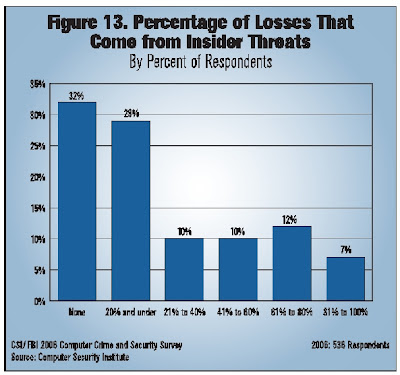
Earlier this week I said Of Course Insiders Cause Fewer Security Incidents . I'm taking heat over at Matasano , but I've got some fresh facts to back me up, after getting a pointer from this Dark Reading story. In short, the 2006 CSI-FBI study is now available , and it confirms my proposition. The study shows there is a new significance for the number "80%". Check out this chart from page 13. If you add up the two left columns, it shows that a clear majority of survey respondents -- 61% -- believe that "none" or 20% or less of their losses come from insiders. In other words, for the clear majority of survey respondents, 80% or more of their losses come from external threats. Why is this? Apparently it's caused by the number one cause of dollar losses -- "virus contamination." "Unauthorized access to information" is a fairly close second, compared to the positions of the other dollar losses. It's interesting that "s...