Posts

Showing posts matching the search for intellectual property

Effective Digital Security Preserves Long-Term Competitiveness

Image
Yesterday I mentioned a speech by my CEO, Jeff Immelt. Charlie Rose also interviewed Mr Immelt last week. In both scenarios Mr Immelt talked about preserving long-term competitiveness. Two of his themes were funding research and development and ensuring the native capability to perform technical tasks. It occurred to me that digital security is reflected in both themes. In Crisis 0: Game Over I asked I'm sure some savvy reader knows of some corporate espionage case that ended badly for the victim, i.e., bankruptcy or the like? I got a few interesting cases, but I believe the net result is that it is difficult to find examples where an intrusion or breach was so devastating that it ended up destroying the victim organization. This makes sense once you reflect on it. Why would a mature, thoughtful intruder seek to destroy his victim, if the purpose of his mission is to conduct espionage on behalf of a competitor or intelligence service? Destroying the victim renders it us...

The Inside Scoop on DoD Thinking

Image
I wanted to help put some of you in the mindset of a DoD person when reading recent news, namely Defense official discloses cyberattack and Pentagon considers preemptive strikes as part of cyber-defense strategy , both by Washington Post reporter Ellen Nakashima. I'll assume you read both articles and the references. Deputy Defense Secretary Lynn's article (covered by the first Post story) is significant, perhaps for reasons that aren't obvious. First, when I wore the uniform, the fact that a classified system suffered a compromise was itself classified. To this day I cannot say if a classified system I used ever suffered a compromise of any kind. Readers might be kind enough to say if this policy is still in effect today. So, to publicly admit such a widespread event -- one that affected classified systems -- that is a big deal. Second, Lynn said "this previously classified incident was the most significant breach of U.S. military computers ever." That is...

Intellectual Property: Develop or Steal

Image
I found the article Internet thieves make big money stealing corporate info in USA Today to be very interesting. In the past year, cybercriminals have begun to infiltrate corporate tech systems as never before. Knowing that some governments and companies will pay handsomely for industrial secrets, data thieves are harvesting as much corporate data as they can, in anticipation of rising demand ... Elite cybergangs can no longer make great money stealing and selling personal identity data. Thousands of small-time, copycat data thieves have oversaturated the market, driving prices to commodity levels. Credit card account numbers that once fetched $100 or more, for instance, can be had for $10 or less, says Gunter Ollmann, chief security strategist at IBM ISS, IBM's tech security division. Who buys stolen business data? Brett Kingstone, founder of Super Vision International (now Nexxus Lighting), an Orlando-based industrial lighting manufacturer, knows the answer all too well. In 20...

Defining the Win

Image
In March I posted Ten Themes From Recent Conferences , which included the following: Permanent compromise is the norm, so accept it. I used to think digital defense was a cycle involving resist -> detect -> respond -> recover. Between recover and the next attack there would be a period where the enterprise could be considered "clean." I've learned now that all enterprises remain "dirty" to some degree , unless massive and cost-prohibitive resources are directed at the problem. We can not stop intruders, only raise their costs . Enterprises stay dirty because we can not stop intruders, but we can make their lives more difficult. I've heard of some organizations trying to raise the $ per MB that the adversary must spend in order to exfiltrate/degrade/deny information.‏ (emphasis added) Since then I've grappled with this idea of how to define the win . If you used to define the win as detecting and ejecting all intruders from your enterprise, y...

Comments on Israeli Intellectual Property Theft Stories

Thanks to Jason Anderson of Lancope for making me aware of a large case of intellectual property theft in Israel. This 29 May story explains how Israeli programmer Michael Haephrati was hired to create Trojan Horses for private investigation companies. Those PI firms then deployed the programs to target companies via "email attachments." The PIs sold what they found to competitors of the targets. For more details, I recommend Richard Steinnon 's blog. I found a detail in this story very interesting: "The Trojan sent images and documents to FTP servers in Israel, Germany and the US, court documents reveal." Regular blog readers know what that means. Any victim company practicing Network Security Monitoring could have complete records of the FTP traffic that carried documents or files stolen by the Trojan Horses. NSM practitioners would know when the activity started, what systems were victims, and when the last outbound connection took place. Dependi...

SEC Guidance Emphasizes Materiality for Cyber Incidents

Image
Senator Jay Rockefeller and Secretary Michael Chertoff wrote the best article I've seen yet on the CF Disclosure Guidance: Topic No. 2, Cybersecurity issued by the SEC last month in their article A new line of defense in cybersecurity, with help from the SEC : Managing cybersecurity risk has always been, and always will be, in large part a private sector responsibility... Until recently, this responsibility may have been unclear — or unknown — to the directors and officers of publicly traded companies. But on Oct. 13, the Securities and Exchange Commission issued groundbreaking guidance to clarify companies’ disclosure obligations about material cybersecurity risks and events. Federal securities law has long required publicly traded companies to report “material” risks and events — that is, information that the average investor would want to know before making an investment decision. But before the SEC’s action, many companies were not aware how — or perhaps even if — this duty a...

Cost of Intellectual Property Theft

Image
I liked the following excerpt from Tim Wilson's story Experts: US Is Not Prepared to Handle Cyber Attacks : If the bad guys launched a coordinated cyber attack on the United States tomorrow, neither government nor industry would be able to stop it, experts warned legislators yesterday. At a hearing held by the House Permanent Select Committee on Intelligence, cyber defense experts testified that government agencies are insufficiently coordinated to handle an attack, and that efforts to build a defense have not adequately addressed issues in the private sector... [Paul] Kurtz [a partner with Good Harbor Consulting and a member of the Center for Strategic and International Studies's (CSIS) Commission on Cybersecurity] registered concerns about the theft of intellectual property from U.S. companies, which he said is occurring at a rate of $200 billion a year. "American industry and government are spending billions of dollars to develop new products and technology that are be...

Google v China

Image
It's been a few months since I mentioned China in a blog post, but this one can't be ignored. Thanks to SW for passing me this one: Google Blog: A New Approach to China In mid-December, we detected a highly sophisticated and targeted attack on our corporate infrastructure originating from China that resulted in the theft of intellectual property from Google... First, this attack was not just on Google. As part of our investigation we have discovered that at least twenty other large companies from a wide range of businesses--including the Internet, finance, technology, media and chemical sectors--have been similarly targeted... These attacks and the surveillance they have uncovered--combined with the attempts over the past year to further limit free speech on the web--have led us to conclude that we should review the feasibility of our business operations in China. We have decided we are no longer willing to continue censoring our results on Google.cn, and so over the next fe...

Republican Presidential Candidates on China

Image
(Photo: Business Insider ) This is not a political blog, so I'm not here to endorse candidates. However, I do want to point out another example of high-level policymakers discussing ongoing activities by China against the US and other developed economies. First, the Washington Post published an editorial by Mitt Romney which included the following: China seeks advantage through systematic exploitation of other economies. It misappropriates intellectual property by coercing “technology transfers” as a condition of market access; enables theft of intellectual property, including patents, designs and know-how; hacks into foreign commercial and government computers ... The result is that China sells high-quality products to the United States at low prices. But too often the source of that high quality is American innovations stolen by Chinese companies. I missed this in August, but former ambassador to China Jon Huntsman said the following during a debate: Huntsman Jr. pointed to Ch...

"Privacy" vs "Security" or Privacy AND Security

Image
Perhaps I'm alone on this, but I may not think of "privacy" and "security" the same way as some readers of this blog. It's common to hear that there is a tension between these two ideas, but I consider them to be very different, at least at the enterprise level. Privacy is primarily concerned with protecting customer data , often called Personally Identifiable Information (PII). Lawyers are typically the dominant players. This field is heavily regulated, with laws requiring disclosure when "records" are lost. The costs of an incident are borne primarily by the individuals whose PII was stolen. Security is primarily concerned with protecting intellectual property , often including trade secrets. Security professionals are typically dominant players. The field is less regulated, since a company loses its own IP. The costs of an incident are borne primarily by the enterprise because they become less competitive. In this sense, an enterprise ...

Review of The Pragmatic CSO

Image
While waiting in the airport, and flying between Ottawa and Washington Dulles, I read a copy of Mike Rothman 's new book The Pragmatic CSO . I was somewhat suspicious of some of the early reviews, since they appeared so quickly after the book was published. You can rest assured that I read the whole book -- and I really liked it. The most important feature of "P-CSO" (as it's called) is that it is a business book . P-CSO teaches readers (assumed to be techies, for the most part) how to think like a businessperson who reports and interacts with other businesspeople. I took business classes in college and graduate school, and I run my own business. Most of the time, however, I'm doing technical work. I usually stay so busy that I don't consciously consider the sorts of business issues Mike describes. Consider the following quote from pages 51-2: The only way to get a seat at the table is by holding yourself to the same standards as everyone else. Operat...

Forcing the Adversary to Pursue Insider Theft

Image
Jack Crook  pointed me toward a story by  Christopher Burgess  about intellectual property theft by "Hongjin Tan, a 35 year old Chinese national and U.S. legal permanent resident... [who] was arrested on December 20 and charged with theft of trade secrets. Tan is alleged to have stolen the trade secrets from his employer, a U.S. petroleum company," according to the criminal complaint filed by the US DoJ. Tan's former employer and the FBI allege that Tan "downloaded restricted files to a personal thumb drive." I could not tell from the complaint if Tan downloaded the files at work or at home, but the thumb drive ended up at Tan's home. His employer asked Tan to bring it to their office, which Tan did. However, he had deleted all the files from the drive. Tan's employer recovered the files using commercially available forensic software. This incident, by definition, involves an "insider threat." Tan was an employee who appears to have cop...

Black Hat Budgeting

Image
Earlier this month I wondered How much to spend on digital security . I'd like to put that question in a different light by imagining what a black hat could do with a $1 million budget. The ideas in this post are rough approximations. They certainly aren't a black hat business plan. I don't recommend anyone follow through on this, although I am sure there are shops our there who do this work already. Let's start by defining the mission of this organization, called Project Intrusion (PI). PI is in "business" to steal intellectual property from organizations and sell it to the highest bidders. In the course of accomplishing that mission, PI may develop tools and techniques that it could sell down the food chain, once PI determines their utility to PI has sufficiently decreased. With $1 million in funding, let's allocate some resources. Staff. Without people, this business goes nowhere. We allocate $750,000 of our budget to salaries and benefits to hi...

Thoughts on Digital Crime

Last week I spoke at and attended the High Technology Crime Investigation Association International Conference and Expo 2004 . The keynote speaker was US Attorney General John Ashcroft. Although I spent time furiously copying notes on his speech, the text is online . Not printed in that text was the AG's repeated theme: the US Department of Justice and Federal Bureau of Investigation are committed to "protecting lives and liberty." I thought this was a curious stance given the recent efforts to scale back the Patriot Act . The AG mentioned that "protect[ing] the United States against cyber-based attacks and high-technology crimes" is the number 3 FBI priority . I believe that if you are a low- to mid-skilled intruder physically located in the United States, you will eventually be caught. The days when hardly anyone cared about prosecuting digital crime are ending. The FBI has 13 Computer Hacking and Intellectual Property (CHIPS) units with plans to op...

The Toughest Question in Digital Security

Image
The toughest question in digital security is "who cares?" The recent Tweet by hogfly (@4n6ir) made me ponder this question. He points to an Aviation Week story by David Fulghum, Bill Sweetman, and Amy Butler titled China's Role In JSF's Spiraling Costs . It says in part: How much of the F-35 Joint Strike Fighter’s spiraling cost in recent years can be traced to China’s cybertheft of technology and the subsequent need to reduce the fifth-generation aircraft’s vulnerability to detection and electronic attack? That is a central question that budget planners are asking, and their queries appear to have validity. Moreover, senior Pentagon and industry officials say other classified weapon programs are suffering from the same problem. Before the intrusions were discovered nearly three years ago, Chinese hackers actually sat in on what were supposed to have been secure, online program-progress conferences, the officials say. The full extent of the connection is stil...

Network Security Monitoring for Fraud, Waste, and Abuse

Image
Recently a blog reader asked the following: You frequently mention "fraud, waste, and abuse" in your writing ( for example ), most often to say that NSM is not intended to address FWA. One thing I've been wondering though--why is fraud in there? I can see waste (employee burning time/resources on ESPN.com or Google Video) or abuse (pornography, etc), but Fraud seems to be in a different class. If someone is using the network to commit a crime, why shouldn't that be in scope? Indeed, preventing loss (monetary, reputational, of intellectual property) is really the bottom line for a strong security program, correct? My stance on this question dates back to my days in the AFCERT. Let me explain by starting with some definitions from AFI90-301 (.pdf): Fraud: Any intentional deception designed to unlawfully deprive the Air Force of something of value or to secure from the Air Force for an individual a benefit, privilege, allowance, or consideration to which he or she is n...

Thoughts on Cisco IOS

Yesterday I mentioned the report of the theft of Cisco's IOS. While I have no evidence to support this theory, I always assumed that various nefarious parties already had access to some or all of Cisco's previous IOS versions. While access to source code is not necessary to discover vulnerabilities, the allure of obtaining such a prize (for intellectual and competitive intelligence pursuits) made theft a likely scenario. The February report of the theft of Microsoft's source surely did not represent the first time unsavory parties had access to that intellectual property, either. What does this event mean for Cisco? I found several excellent News.com articles which gave me food for thought. First, last month News.com reported that Cisco will release a new version of IOS on a new product this summer. This new device, the Huge Faster Router (HFR), is designed to compete with Juniper's core routing product , the T640 (Juniper gear pictured below). The new vers...

Expect to Hear "IDS Is Dead" (Again)

Image
Do you remember when IDS was dead , and supposed to be replaced by "thought-leading firewalls" by 2005? Well, that prediction died pretty quickly. However, I expect to hear it again after reading DIB cybersecurity pilot has stopped 'hundreds' of intrusions, says Lynn : About 20 companies participate in the Defense Department's 90-day pilot for an active network defense capability for the defense industrial base analogous to the Homeland Security Department's Einstein 3 effort, said Deputy Defense Secretary William Lynn. During an address to the 2011 DISA Customer and Industry Forum in Baltimore, Md., Lynn said the sharing of malicious code signatures gathered through intelligence efforts to pilot participants has already stopped "hundreds of intrusions." Lynn also laid blame for intrusions into military and defense industrial base networks on "foreign intelligence services," stating that they have stolen military plans, weapons...

Inside a Congressional Hearing on Digital Threats

Image
Today I was fortunate to attend a hearing of the US House Permanent Select Committee on Intelligence (HPSCI). That's me on the far left of the photo, seated behind our MANDIANT CEO Kevin Mandia. I'd like to share a few thoughts on the experience. First, I was impressed by the attitudes of all those involved with HPSCI, from the staffers to the Representatives themselves. They were all courteous and wanted to hear the opinions of Kevin and the other two witnesses (Art Coviello from RSA and Michael Hayden from the Chertoff Group), whether before, during, or after the hearing. Second, I thought Reps Mike Rogers (R-MI, HPSCI Chairman) and C.A. Dutch Ruppersberger (D-MD, HPSCI Ranking Member) offered compelling opening statements. Rep Rogers squarely pointed the finger at our overseas adversaries. As reported by PCWorld in U.S. Lawmakers Point to China as Cause of Cyberattacks , Rep Rogers said: "I don't believe that there is a precedent in history for such a massive...

Thoughts on 2011 ONCIX Report

Image
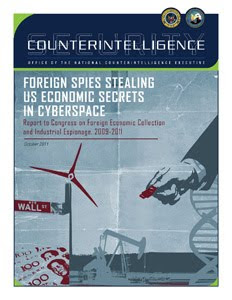
Many of you have probably seen coverage of the 2011 ONCIX Reports to Congress: Foreign Economic and Industrial Espionage . I recommend every security professional read the latest edition (.pdf). I'd like to highlight the key findings of the 2011 version: Pervasive Threat from Adversaries and Partners Sensitive US economic information and technology are targeted by the intelligence services, private sector companies, academic and research institutions, and citizens of dozens of countries. • Chinese actors are the world’s most active and persistent perpetrators of economic espionage. US private sector firms and cybersecurity specialists have reported an onslaught of computer network intrusions that have originated in China, but the IC cannot confirm who was responsible. • Russia’s intelligence services are conducting a range of activities to collect economic information and technology from US targets. • Some US allies and partners use their broad access to US institutions to acqui...