Posts

If You Can't Patch Your Email Server, You Should Not Be Running It

Image
CVE-2020-0688 Scan Results, per Rapid7 tl;dr -- it's the title of the post: "If You Can't Patch Your Email Server, You Should Not Be Running It." I read a disturbing story today with the following news: "Starting March 24, Rapid7 used its Project Sonar internet-wide survey tool to discover all publicly-facing Exchange servers on the Internet and the numbers are grim. As they found, 'at least 357,629 (82.5%) of the 433,464 Exchange servers' are still vulnerable to attacks that would exploit the CVE-2020-0688 vulnerability. To make matters even worse, some of the servers that were tagged by Rapid7 as being safe against attacks might still be vulnerable given that 'the related Microsoft update wasn’t always updating the build number.' Furthermore, 'there are over 31,000 Exchange 2010 servers that have not been updated since 2012 ,' as the Rapid7 researchers observed. ' There are nearly 800 Exchange 2010 servers that have...

Seeing Book Shelves on Virtual Calls

Image
I have a confession... for me, the best part of virtual calls, or seeing any reporter or commentator working for home, is being able to check out their book shelves. I never use computer video, because I want to preserve the world's bandwidth. That means I don't share what my book shelves look like when I'm on a company call. Therefore, I thought I'd share my book shelves with the world. My big categories of books are martial arts, mixed/miscellaneous, cybersecurity and intelligence, and military and Civil War history. I've cataloged about 400 print books and almost 500 digital titles. Over the years I've leaned towards buying Kindle editions of any book that is mostly print, in order to reduce my footprint. For the last many years, my book shelving has consisted of three units, each with five shelves. Looking at the topic distribution, as of 2020 I have roughly 6 shelves for martial arts, 4 for mixed/miscellaneous, 3 for cybersecurity and intelligence, a...

Skill Levels in Digital Security

Image
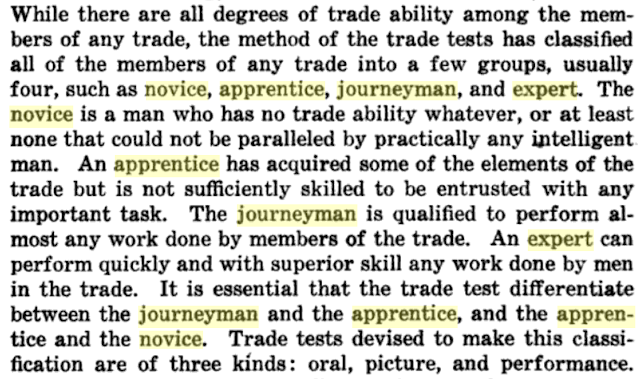
Two posts in one day? These are certainly unusual times. I was thinking about words to describe different skill levels in digital security. Rather than invent something, I decided to review terms that have established meaning. Thanks to Google Books I found this article in a 1922 edition of the Archives of Psychology that mentioned four key terms: The novice is a (person) who has no trade ability whatever, or at least none that could not be paralleled by practically any intelligent (person). An apprentice has acquired some of the elements of the trade but is not sufficiently skilled to be trusted with any important task. The journey(person) is qualified to perform almost any work done by members of the trade. An expert can perform quickly and with superior skill any work done by (people) in the trade. I believe these four categories can apply to some degree to the needs of the digital security profession. At GE-CIRT we had three levels -- event analyst, incident...

When You Should Blog and When You Should Tweet

Image
I saw my like-minded, friend-that-I've-never-met Andrew Thompson Tweet a poll , posted above. I was about to reply with the following Tweet: "If I'm struggling to figure out how to capture a thought in just 1 Tweet, that's a sign that a blog post might be appropriate. I only use a thread, and no more than 2, and hardly ever 3 (good Lord), when I know I've got nothing more to say. "1/10," "1/n," etc. are not for me." Then I realized I had something more to say, namely, other reasons blog posts are better than Tweets. For the briefest moment I considered adding a second Tweet, making, horror of horrors, a THREAD, and then I realized I would be breaking my own guidance. Here are three reasons to consider blogging over Tweeting. 1. If you find yourself trying to pack your thoughts into a 280 character limit, then you should write a blog post. You might have a good idea, and instead of expressing it properly, you're falling into...

COVID-19 Phishing Tests: WRONG

Malware Jake Tweeted a poll last night which asked the following: "I have an interesting ethical quandary. Is it ethically okay to use COVID-19 themed phishing emails for assessments and user awareness training right now? Please read the thread before responding and RT for visibility. 1/" Ultimately he decided : "My gut feeling is to not use COVID-19 themed emails in assessments/training, but to TELL users to expect them, though I understand even that might discourage consumption of legitimate information, endangering public health. 6/" I responded by saying this was the right answer. Thankfully there were many people who agreed, despite the fact that voting itself was skewed towards the "yes" answer. There were an uncomfortable number of responses to the Tweet that said there's nothing wrong with red teams phishing users with COVID-19 emails. For example: "Do criminals abide by ethics? Nope. Neither should testing." "Ye...

Seven Security Strategies, Summarized

This is the sort of story that starts as a comment on Twitter, then becomes a blog post when I realize I can't fit all the ideas into one or two Tweets. (You know how much I hate Tweet threads, and how I encourage everyone to capture deep thoughts in blog posts!) In the interest of capturing the thought, and not in the interest of thinking too deeply or comprehensively (at least right now), I offer seven security strategies, summarized. When I mention the risk equation, I'm talking about the idea that one can conceptually image the risk of some negative event using this "formula": Risk (of something) is the product of some measurements of Vulnerability X Threat X Asset Value, or R = V x T x A. Denial and/or ignorance. This strategy assumes the risk due to loss is low, because those managing the risk assume that one or more of the elements of the risk equation are zero or almost zero, or they are apathetic to the cost. Loss acceptance. This strategy may assume...

Five Thoughts on the Internet Freedom League

Image
In the September/October issue of Foreign Affairs magazine, Richard Clarke and Rob Knake published an article titled " The Internet Freedom League: How to Push Back Against the Authoritarian Assault on the Web ," based on their recent book The Fifth Domain . The article proposes the following: The United States and its allies and partners should stop worrying about the risk of authoritarians splitting the Internet.  I nstead, they should split it themselves, by creating a digital bloc within which data, services, and products can flow freely, excluding countries that do not respect freedom of expression or privacy rights, engage in disruptive activity, or provide safe havens to cybercriminals... The league would not raise a digital Iron Curtain; at least initially, most Internet traffic would still flow between members and nonmembers, and the league would primarily block companies and organizations that aid and abet cybercrime, rather than entire countries.  Governm...