Posts

Five Thoughts on New China Article

Image
I just read a thoughtful article by Michael O'Hanlon and James Steinberg, posted at Brookings and Foreign Policy titled Don't Be a Menace to South (China Sea) . It addresses thorny questions regarding China as President Obama visits South Korea, Japan, Malaysia, and the Philippines. I wanted to share five quick thoughts on the article, fully appreciating I don't have all the answers to this complex strategic problem. 1. "Many in China see the U.S. rebalance as ill-disguised containment, while many in the United States see Chinese military modernization and territorial assertiveness as strong indications that Beijing seeks to undermine Washington's alliances and drive the United States from the Western Pacific." I agree with these statements as being perceptions by both sides, but I also think they are closer to the truth than what the authors believe. I recommend Dr Ashley Tellis' monograph  Balancing Without Containment: An American Strategy for...

Are Nation States Responsible for Evil Traffic Leaving Their Networks?

Image
During recent talks to various audiences, I've mentioned discussions within the United Nations. One point from these discussions involved certain nation states agreeing to modes of behavior in cyber space. I found the document containing these recent statements: A/68/98, Group of Governmental Experts on Developments in the Field of Information and Telecommunications in the Context of International Security  (pdf). This document is hosted within the United Nations Office for Disarmament Affairs , in the  developments in the field of information and telecommunications section. Fifteen countries were involved in producing this document: Argentina, Australia, Belarus, Canada, China, Egypt, Estonia, France, Germany, India, Indonesia, Japan, the Russian Federation, the United Kingdom of Great Britain and Northern Ireland and the United States of America. Within the section titled "Recommendations on norms, rules and principles of responsible behaviour by States," I ...

Five Thoughts from VADM Rogers Testimony

Image
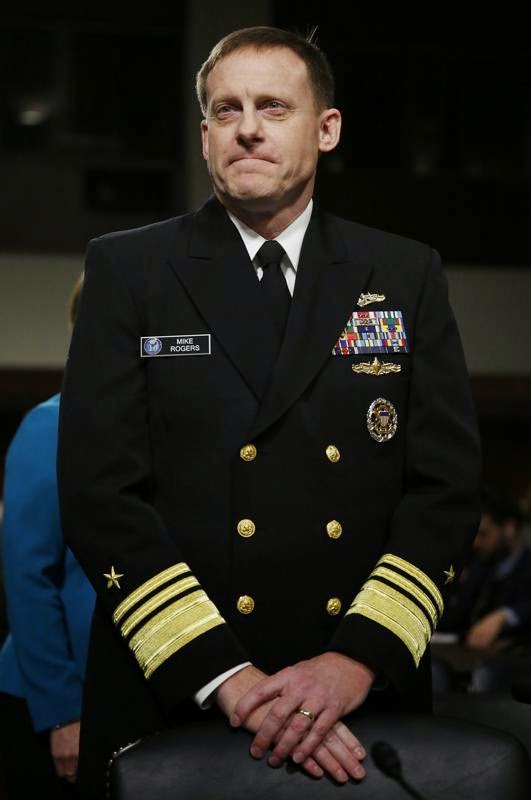
I had a chance to read  Advance Questions for Vice Admiral Michael S. Rogers, USN (pdf) this weekend. I wanted to share five thoughts based on excerpts from the VADM Rogers' answers to written questions posed by the Senate Armed Services Committee. 1. The Committee asked: Can deterrence be an effective strategy in the absence of reliable attribution? VADM Rogers responded: Yes, I believe there can be effective levels of deterrence despite the challenges of attribution. Attribution has improved, but is still not timely in many circumstances... Cyber presence, being forward deployed in cyberspace , and garnering the indications and warnings of our most likely adversaries can help (as we do with our forces dedicated to Defend the Nation). (emphasis added) I wonder if "cyber presence" and "being forward deployed in cyberspace" means having access to adversary systems? There's little doubt as to the source of an attack if you are resident on the sy...

Bejtlich Teaching at Black Hat USA 2014

Image
I'm pleased to announce that I will be teaching one class at  Black Hat USA 2014   2-3 and 4-5 August 2014 in Las Vegas, Nevada. The class is  Network Security Monitoring 101 . I've taught this class in Las Vegas in July 2013 and Seattle in December 2013. I posted  Feedback from Network Security Monitoring 101 Classes  last year as a sample of the student commentary I received. This class is the perfect jumpstart for anyone who wants to begin a network security monitoring program at their organization. You may enter with no NSM knowledge, but when you leave you'll be able to understand, deploy, and use NSM to detect and respond to intruders, using open source software and repurposed hardware. The first discounted registration deadline is 11:59 pm EDT June 2nd. The second discounted registration deadline (more expensive than the first but cheaper than later) ends 11:59 pm EDT July 26th. You can  register here . Please note: I have no plans ...

The Limits of Tool- and Tactics-Centric Thinking

Image
Earlier today I read a post by Dave Aitel to his mailing list titled  Drinking the Cool-aid . Because it includes a chart you should review, I included a screenshot of it in this blog, below. Basically Dave lists several gross categories of defensive digital security technology and tools, then lists what he perceives as deficiencies and benefits of each. Embedded in these pluses and minuses are several tactical elements as well. Please take a look at the original or my screenshot. I had three reactions to this post. First, I recognized that it's written by someone who is not responsible for defending any network of scale or significance. Network defense is more than tools and tactics. It's more often about people and processes. My initial response is unsatisfying and simplistic, however, even though I agree broadly with his critiques of anti-virus, firewalls, WAFs, and some traditional security technology. Second, staying within the realm of tools and tactics, Dave i...

More Russian Information Warfare

Image
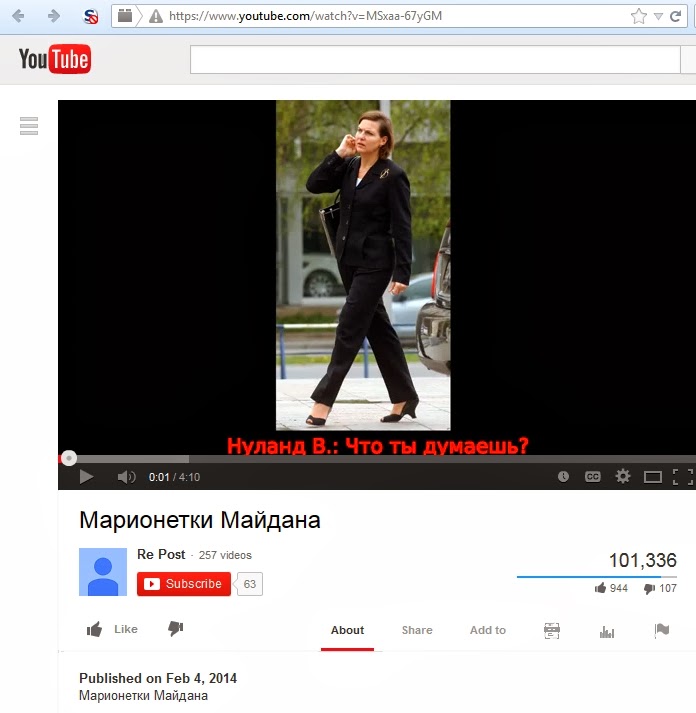
In all the hype about "cyberspace" and "cyberwar," it's easy to forget about information warfare. This term was in vogue in the military when I was an Air Force intelligence officer in the 1990s. The Russians were considered to be experts at using information to their advantage and they appear to continue to wield that expertise on a regular basis. The latest incarnation goes like this: 1. Unknown parties, probably Russian SIGINT operators, intercept and record a phone call between US Assistant Secretary of State Victoria Nuland and US Ambassador to Ukraine, Geoffrey Pyatt. In the phone call, the parties use language which could be considered inflammatory or insulting to EU politicians. 2. The interceptors pass the phone call recording to a private third party. 3. Either that third party, or some recipient down the line, posts the audio and a video overlay on Youtube . 4. The third party Tweets about the video. 5. Russian-sponsored television...

Quick Thought on Internet Governance and Edward Snowden

Image
I am neither an Internet governance expert nor am I personally consumed by the issue. However, I wanted to point out a possible rhetorical inconsistency involving the Internet governance debate and another hot topic, theft of secret documents by insiders, namely Edward Snowden. Let me set the stage. First, Internet governance. Too often the Internet governance debate is reduced to the following. One side is characterized as "multi-stakeholder," consisting of various nongovernmental parties with overlapping agendas, like ICANN, IANA, IETF, etc. This side is often referred to as "the West" (thanks to the US, Canada, Europe, etc. being on this side), and is considered a proponent of an "open" Internet. The other side aligns with state governments and made its presence felt at the monumental December 2012 ITU World Conference on International Telecommunications (WCIT) meeting. This side is often referred to as "the East" (thanks to Russia, China, t...