Posts

Mandiant APT1 Report: 25 Best Commentaries of the Last 12 Days

Image
Two weeks ago today our team at Mandiant was feverishly preparing the release of our APT1 report . In the twelve days that followed publication on the evening of Monday the 18th, I've been very pleased by the amount of constructive commentary and related research published online. In this post I'd like to list those contributions that I believe merit attention, in the event you missed them the first time around. These sorts of posts are examples of what the security community can do to advance our collective capability to counter digital threats. Please note I avoided mass media accounts, interviews with Mandiant team members, and most general commentary. They are listed in no particular order. Seth Hall (Bro): Watching for the APT1 Intelligence Jason Wood (SecureIdeas): Reading the Mandiant APT1 Report Chris Sanders: Making the Mandiant APT1 Report Actionable Symantec: APT1: Q&A on Attacks by the Comment Crew Tekdefense (NoVA Infosec): MASTIFF Analysis of APT...

Recovering from Suricata Gone Wild

Recently I tried interacting with one of my lab Security Onion sensors running the Suricata IDS. I found the Sguil server was taking a really long time to offer services on port 7734 TCP. Since I hadn't worked with this lab system in a while, I guessed that there might be too many uncategorized events in the Sguil database. I dusted off an old blog post titled More Snort and Sguil Tuning from 2006 and took a look at the system. First I stopped the NSM applications on the server. sudo service nsm stop Stopping: securityonion * stopping: sguil server [ OK ] Stopping: HIDS * stopping: ossec_agent (sguil) [ OK ] Stopping: Bro stopping ds61so-eth1-1 ... stopping proxy ... stopping manager ... Stopping: ds61so-eth1 * stopping: netsniff-ng (full packet data) [ OK ] * stopping: pcap_agent (sguil) [ OK ] * stopping: snort_agent (sguil) [ OK ] * stoppi...

Using Bro to Log SSL Certificates

Image
I remember using an older version of Bro to log SSL certificates extracted from the wire. The version shipped with Security Onion is new and that functionality doesn't appear to be enabled by default. I asked Seth Hall about this capability, and he told me how to get Bro to log all SSL certs that it sees. Edit /opt/bro/share/bro/site/local.bro to contain the changes as shown below. diff -u /opt/bro/share/bro/site/local.bro.orig /opt/bro/share/bro/site/local.bro --- /opt/bro/share/bro/site/local.bro.orig 2013-02-23 01:54:53.291457193 +0000 +++ /opt/bro/share/bro/site/local.bro 2013-02-23 01:55:16.151996423 +0000 @@ -56,6 +56,10 @@ # This script enables SSL/TLS certificate validation. @load protocols/ssl/validate-certs +# Log certs per Seth +@load protocols/ssl/extract-certs-pem +redef SSL::extract_certs_pem = ALL_HOSTS; + # If you have libGeoIP support built in, do some geographic detections and # logging for SSH traffic. @load protocols/ssh/geo-data Restart Bro. ...

Practical Network Security Monitoring Book on Schedule

Image
First the good news: my new book Practical Network Security Monitoring is on track, and you can pre-order with a 30% discount using code NSM101 . I'm about 1/3 of the way through writing the book. Since I announced the project last month, I've submitted chapters 1, 2, and 3. They are in various stages of review by No Starch editors and my technical editors. I seem to be writing more than I expected, despite trying to keep the book at an introductory level. I find that I want to communicate the topic sufficiently to make my point, but I try to avoid going too deeply into related areas. I'm also encountering situations where I have to promise to explain some concepts later, rather than explain everything immediately. I believe once I get the first chapter ironed out with the editor, the rest will be easier to digest. I'm taking a fairly methodical approach (imagine that), so once the foundation in chapter 1 is done the rest is more straightforward. I'm keeping a...

On Thought Leadership and Non-Technical Relevance

Image
A reader left a comment on my post 2012: The Year I Changed What I Read . He said: Richard, it's interesting to note that your career has shifted from "pure" technology to more of a thought leadership role where you can leverage your training and interest in history, political science, etc. I wonder if you ever expected to become such a public figure in the whole debate about China when you first started with infosec? Your career path is an encouraging example for others to follow. Even though I work in technology, I also have a sociology/political science background and I've been wondering how I can leverage those interests, especially as I get older and cheaper/hungrier techies continue to enter the industry. Thank you for your comment and question. I will try to answer here. I did not plan to become a "public" figure, and I don't necessarily consider myself exceptionally "public" now. I just reviewed my TaoSecurity news page to see wh...

How to Win This TCP/IP Book

Image
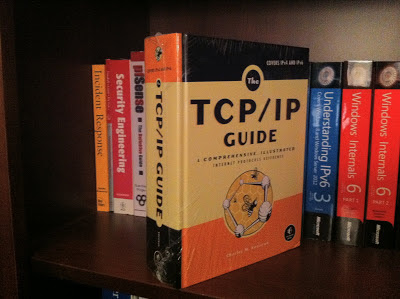
Last week I wished this blog happy tenth birthday and announced plans for a new book on network security monitoring . I also mentioned a contest involving a book give-away. I finally figured out a good way to select a winner, and it involves your participation in my current writing project! Thanks to No Starch Press I have a brand-new, shrink-wrapped copy of The TCP/IP Guide , a mammoth 1616 page hardcover book by Charles M. Kozierok. Here's what you have to do to try to win this book: submit a case study on how network security monitoring helped you detect, respond to, and contain an intrusion in your environment . You don't have to reveal your organization, but I want to know some general information like the number of users and computers. Readers need to know the sort of environment where NSM worked for you, but I don't want you to reveal your organization (unless you want to). Tell the reader what happened, what NSM data you used, how you used it, and how you ha...

Bejtlich's New Book: Planned for Summer Publication

Image
Nearly ten years after I started writing my first book , the Tao of Network Security Monitoring , I'm pleased to announce that I just signed a contract to write a new book for No Starch titled Network Security Monitoring in Minutes . From the book proposal: Network Security Monitoring in Minutes provides the tactics, techniques, and procedures for maximum enterprise defense in a minimum amount of time. Network Security Monitoring (NSM) is the collection, analysis, and escalation of indications and warnings to detect and respond to intrusions. Network Security Monitoring in Minutes teaches information technology and security staff how to leverage powerful NSM tools and concepts immediately. Using open source software and vendor-neutral methods, the author applies lessons he first began applying to military networks in 1998. After reading this book, the audience will be able to integrate the same winning approaches to better defend his or her company’s data and networks. Net...