Posts

Thoughts on OSSEC Con 2019

Image
Last week I attended my first OSSEC conference. I first blogged about OSSEC in 2007, and wrote other posts about it in the following years. OSSEC is a host-based intrusion detection and log analysis system with correlation and active response features. It is cross-platform, such that I can run it on my Windows and Linux systems. The moving force behind the conference was a company local to me called Atomicorp . In brief, I really enjoyed this one-day event. (I had planned to attend the workshop on the second day but my schedule did not cooperate.) The talks were almost uniformly excellent and informative. I even had a chance to talk jiu-jitsu with OSSEC creator Daniel Cid, who despite hurting his leg managed to travel across the country to deliver the keynote. I'd like to share a few highlights from my notes. First, I had been worried that OSSEC was in some ways dead. I saw that the Security Onion project had replaced OSSEC with a fork called Wazuh, which I learned is a...
Thoughts on Cloud Security

Image
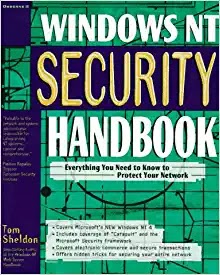
Recently I've been reading about cloud security and security with respect to DevOps. I'll say more about the excellent book I'm reading, but I had a moment of déjà vu during one section. The book described how cloud security is a big change from enterprise security because it relies less on IP-address-centric controls and more on users and groups. The book talked about creating security groups, and adding users to those groups in order to control their access and capabilities. As I read that passage, it reminded me of a time long ago, in the late 1990s, when I was studying for the MCSE, then called the Microsoft Certified Systems Engineer. I read the book at left, Windows NT Security Handbook, published in 1996 by Tom Sheldon. It described the exact same security process of creating security groups and adding users. This was core to the new NT 4 role based access control (RBAC) implementation. Now, fast forward a few years, or all the way to today, and consider the ...

Forcing the Adversary to Pursue Insider Theft

Image
Jack Crook  pointed me toward a story by  Christopher Burgess  about intellectual property theft by "Hongjin Tan, a 35 year old Chinese national and U.S. legal permanent resident... [who] was arrested on December 20 and charged with theft of trade secrets. Tan is alleged to have stolen the trade secrets from his employer, a U.S. petroleum company," according to the criminal complaint filed by the US DoJ. Tan's former employer and the FBI allege that Tan "downloaded restricted files to a personal thumb drive." I could not tell from the complaint if Tan downloaded the files at work or at home, but the thumb drive ended up at Tan's home. His employer asked Tan to bring it to their office, which Tan did. However, he had deleted all the files from the drive. Tan's employer recovered the files using commercially available forensic software. This incident, by definition, involves an "insider threat." Tan was an employee who appears to have cop...

Fixing Virtualbox RDP Server with DetectionLab

Yesterday I posted about DetectionLab , but noted that I was having trouble with the RDP servers offered by Virtualbox. If you remember, DetectionLab builds four virtual machines: root@LAPTOP-HT4TGVCP C:\Users\root> "c:\Program Files\Oracle\VirtualBox\VBoxManage" list runningvms "logger" {3da9fffb-4b02-4e57-a592-dd2322f14245} "dc.windomain.local" {ef32d493-845c-45dc-aff7-3a86d9c590cd} "wef.windomain.local" {7cd008b7-c6e0-421d-9655-8f92ec98d9d7} "win10.windomain.local" {acf413fb-6358-44df-ab9f-cc7767ed32bd} I was having a problem with two of the VMs sharing the same port for the RDP server offered by Virtualbox. This meant I could not access one of them. (Below, port 5932 has the conflict.) root@LAPTOP-HT4TGVCP C:\Users\root\git\detectionlab\DetectionLab\Vagrant> "c:\Program Files\Oracle\VirtualBox\VBoxManage" showvminfo logger | findstr /I vrde  | findstr /I address VRDE:                        enabled (Ad...

Trying DetectionLab

Image
Many security professionals run personal labs. Trying to create an environment that includes fairly modern Windows systems can be a challenge. In the age of "infrastructure as code," there should be a simpler way to deploy systems in a repeatable, virtualized way -- right? Enter DetectionLab , a project by Chris Long . Briefly, Chris built a project that uses Packer and Vagrant to create an instrumented lab environment. Chris explained the project in late 2017 in a Medium post , which I recommend reading. I can't even begin to describe all the functionality packed into this project. So much of it is new, but this is a great way to learn about it. In this post, I would like to show how I got a version of DetectionLab running. My build environment included a modern laptop with 16 GB RAM and Windows 10 professional. I had already installed Virtualbox 6.0 with the appropriate VirtualBox Extension Pack. I had also enabled the native OpenSSH server and performed all...