Posts

Why Do SOCs Look Like This?

Image
When you hear the word "SOC," or the phrase "security operations center," what image comes to mind? Do you think of analyst sitting at desks, all facing forward, towards giant screens? Why is this? The following image is from the outstanding movie Apollo 13, a docudrama about the challenged 1970 mission to the moon. It's a screen capture from the go for launch sequence. It shows mission control in Houston, Texas. If you'd like to see video of the actual center from 1970, check out This Is Mission Control . Mission control looks remarkably like a SOC, doesn't it? When builders of computer security operations centers imagined what their "mission control" rooms would look like, perhaps they had Houston in mind? Or perhaps they thought of the 1983 movie War Games? Reality was way more boring however: I visited NORAD under Cheyenne Mountain in 1989, I believe, when visiting the Air Force Academy as a high school senior. I can c...

Bejtlich on the APT1 Report: No Hack Back

Image
Before reading the rest of this post, I suggest reading Mandiant/FireEye's statement Doing Our Part -- Without Hacking Back . I would like to add my own color to this situation. First, at no time when I worked for Mandiant or FireEye, or afterwards, was there ever a notion that we would hack into adversary systems. During my six year tenure, we were publicly and privately a "no hack back" company. I never heard anyone talk about hack back operations. No one ever intimated we had imagery of APT1 actors taken with their own laptop cameras. No one even said that would be a good idea. Second, I would never have testified or written, repeatedly, about our company's stance on not hacking back if I knew we secretly did otherwise. I have quit jobs because I had fundamental disagreements with company policy or practice. I worked for Mandiant from 2011 through the end of 2013, when FireEye acquired Mandiant, and stayed until last year (2017). I never considered quitting...

Bejtlich Joining Splunk

Image
Since posting Bejtlich Moves On I've been rebalancing work, family, and personal life. I invested in my martial arts interests , helped more with home duties, and consulted through TaoSecurity . Today I'm pleased to announce that, effective Monday May 21st 2018, I'm joining the Splunk team. I will be Senior Director for Security and Intelligence Operations, reporting to our CISO, Joel Fulton. I will help build teams to perform detection and monitoring operations, digital forensics and incident response, and threat intelligence. I remain in the northern Virginia area and will align with the Splunk presence in Tyson's Corner. I'm very excited by this opportunity for four reasons. First, the areas for which I will be responsible are my favorite aspects of security. Long-time blog readers know I'm happiest detecting and responding to intruders! Second, I already know several people at the company, one of whom began this journey by Tweeting about opportu...

Trying Splunk Cloud

Image
I first used Splunk over ten years ago, but the first time I blogged about it was in 2008. I described how to install Splunk on Ubuntu 8.04 . Today I decided to try the Splunk Cloud . Splunk Cloud is the company's hosted Splunk offering, residing in Amazon Web Services (AWS). You can register for a 15 day free trial of Splunk Cloud that will index 5 GB per day. If you would like to follow along, you will need a computer with a Web browser to interact with Splunk Cloud. (There may be ways to interact via API, but I do not cover that here.) I will collect logs from a virtual machine running Debian 9, inside Oracle VirtualBox. First I registered for the free Splunk Cloud trial online. After I had a Splunk Cloud instance running, I consulted the documentation for Forward data to Splunk Cloud from Linux . I am running a "self-serviced" instance and not a "managed instance," i.e., I am the administrator in this situation. I learned that I needed to ins...

Importing Pcap into Security Onion

Image
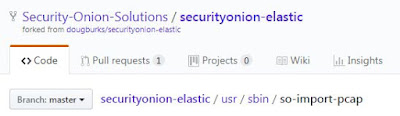
Within the last week, Doug Burks of Security Onion  (SO) added a new script that revolutionizes the use case for his amazing open source network security monitoring platform. I have always used SO in a live production mode, meaning I deploy a SO sensor sniffing a live network interface. As the multitude of SO components observe network traffic, they generate, store, and display various forms of NSM data for use by analysts. The problem with this model is that it could not be used for processing stored network traffic. If one simply replayed the traffic from a .pcap file, the new traffic would be assigned contemporary timestamps by the various tools observing the traffic. While all of the NSM tools in SO have the independent capability to read stored .pcap files, there was no unified way to integrate their output into the SO platform. Therefore, for years, there has not been a way to import .pcap files into SO -- until last week! Here is how I tested the new so-import-pc...

Lies and More Lies

Image
Following the release of the Spectre and Meltdown CPU attacks, the security community wondered if other researchers would find related speculative attack problems. When the following appeared, we were concerned: "Skyfall and Solace More vulnerabilities in modern computers. Following the recent release of the Meltdown and Spectre vulnerabilities, CVE-2017-5175, CVE-2017-5753 and CVE-2017-5754, there has been considerable speculation as to whether all the issues described can be fully mitigated.  Skyfall and Solace are two speculative attacks based on the work highlighted by Meltdown and Spectre. Full details are still under embargo and will be published soon when chip manufacturers and Operating System vendors have prepared patches. Watch this space..." It turns out this was a hoax. The latest version of the site says, in part: "With little more than a couple of quickly registered domain names, thousands of people were hooked... Skyfall The idea he...

Addressing Innumeracy in Reporting

Image
Anyone involved in cybersecurity reporting needs a strong sense of numeracy, or mathematical literacy. I see two sorts of examples of innumeracy repeatedly in the media. The first involves the time value of money. Recently CNN claimed Amazon CEO Jeff Bezos was the "richest person in history" and Recode said Bezos was "now worth more than Bill Gates ever was." Thankfully both Richard Steinnon and Noah Kirsch recognized the foolishness of these reports, correctly noting that Bezos would only rank number 17 on a list where wealth was adjusted for inflation . This failure to recognize the time value of money is pervasive. Just today I heard the host of a podcast claim that the 1998 Jackie Chan movie Rush Hour was "the top grossing martial arts film of all time." According to Box Office Mojo , Rush Hour earned $244,386,864 worldwide. Adjusting for inflation , in 2017 dollars that's $367,509,865.67 -- impressive! For comparison, I researched the ...