Posts

Scalable Infrastructure vs Large Problems, or OpenDNS vs Conficker

Image
After seeing Dan Kaminsky's talk at Black Hat DC last month, I blogged about the benefits of DNS' ability to scale to address big problems like asset management records . I've avoid talking about Conficker (except for yesterday ) since it's all over the media. Why mention DNS and Conficker in the same post? All of the commotion about Conficker involves one variant's activation of a new domain generation algorithm on 1 April. Until today no one had publicly announced the reverse engineering of the algorithm, but right now you can download a list of 50,014 domains that one Conficker variant will select from when trying to phone home starting 1 April. Some of the domains appear to be pre-empted: $ whois aadqnggvc.com.ua % This is the Ukrainian Whois query server #B. % Rights restricted by copyright. % % % .UA whois % Domain Record: % ============= domain: aadqnggvc.com.ua admin-c: CCTLD-UANIC tech-c: CCTLD-UANIC status: FROZEN-OK-UNTIL 200907010000...
NSM vs The Cloud

Image
A blog reader posted the following comment to my post Network Security Monitoring Lives : How do you use NSM to monitor the growing population of remote, intermittently connect mobile computing devices? What happens when those same computers access corporate resource hosted by a 3rd party such as corporate SaaS applications or storage in the cloud? This is a great question. The good news is we are already facing this problem today. The answer to the question can be found in a few old principles I will describe below. Something is better than nothing. I've written about this elsewhere: computer professionals tend to think in binary terms, i.e., all or nothing. A large number of people I encounter think 'if I can't get it all, I don't want anything." That thinking flies in the face of reality. There are no absolutes in digital security, or analog security for that matter. I already own multiple assets that do not strictly reside on any single network that I ...

Response to 60 Minutes Story "The Internet Is Infected"

Image
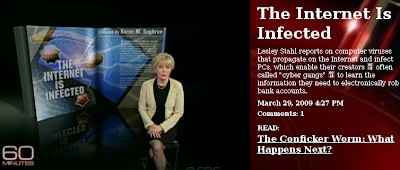
I just watched the 60 Minutes story The Internet Is Infected . I have mixed feelings about this story, but I think you can still encourage others to watch and/or read it. Overall I think the effect will be positive, because it often takes a story from a major and fairly respected news source to grab the attention of those who do not operationally defend networks. I'd like to outline the negative and positive aspects of the story, in my humble point of view. The negative aspects are as follows: I detest the term "infected." Computers in 2009 are not "infected." They are compromised by malware operated by a human with an objective. The malware is a tool; it is not the end goal. In the late 1990s I enjoyed defending networks because the activity I monitored was caused by a human, live on the Internet, whose very keystrokes I could watch. At the beginning of this decade I despaired as human action was drowned in a sea of malware that basically propagated but...

Network Security Monitoring Lives

Image
Every once in a while I will post examples of why Network Security Monitoring works in a world where Webbed, Virtual, Fluffy Clouds abound and people who pay attention to network traffic are considered stupid network security geeks . One of the best posts I've seen on the worm-of-the-week, Conficker, is Risk, Group Think and the Conficker Worm by the Verizon Security Blog. The post says: With the exception of new customers who have engaged our Incident Response team specifically in response to a Conficker infection, Verizon Business customers have reported only isolated or anecdotal Conficker infections with little or no broad impact on operations. A very large proportion of systems we have studied, which were infected with Conficker in enterprises, were “unknown or unmanaged” devices. Infected systems were not part of those enterprise’s configuration, maintenance, or patch processes. In one study a large proportion of infected machines were simply discarded because a current...

NSM on Cisco AXP?

Image
Last year I wrote Run Apps on Cisco ISR Routers . That was two weeks after our April Fool's joke that the Sguil Project Was Acquired by Cisco . I am wondering if any TaoSecurity Blog readers are using Cisco AXP in production? Looking at the data sheet for the modules, they appear too underpowered for NSM applications, especially at the price point Cisco is advertising. Richard Bejtlich is teaching new classes in Europe and Las Vegas in 2009. Online Europe registration ends by 1 Apr, and seats are filling. Early Las Vegas registration ends 1 May.

Association of Former Information Warriors

Image
In response to my TaoSecurity Blog post titled Buck Surdu and Greg Conti Ask "Is It Time for a Cyberwarfare Branch?" , I decided to create the Association of Former Information Warriors. I set up a LinkedIn Group with the following description: The Association of Former Information Warriors is a professional networking group for those who once served as military members in information operations (IO) or warfare (IW) units. The mission of the AOFIW is to propose, promote, and debate policies and strategies to preserve, protect, and defend digital national security interests. Candidate members must be referred by current members. Those no longer in military service are candidates for full membership; those currently serving in uniform are candidates for associate membership. In other words, to join AOFIW you need to know an existing member. This weekend I am going to try kickstarting the membership process by inviting those I personally know and trust to meet these criteria...

More PowerPoint Woes

Image
Last year I attended The Best Single Day Class Ever , taught by Prof. Tufte. He changed my outlook on PowerPoint for ever. Today in FCW magazine I found a pointer to 8 PowerPoint Train Wrecks , like the slide Bill Gates is presenting at left. While following some of the linked presentations, I came across this line from the shmula blog : While at Amazon, we were all told by Divine Fiat that ALL presentations — regardless of kind, cannot ever be on Powerpoint. Period. Bezos prefers prose and actual thoughts slapped in a report — an actual paper report with paragraphs, charts, sentences, an executive summary, introduction of problem, research approach and findings (body of paper), conclusions and recommendations — not choppy, half-thoughts on a gazillion slides. Thank goodness. I am not crazy after all. That same blog post makes other good points, and links to an imagined Barack Obama "Yes We Can" PowerPoint deck . Hilarious. Richard Bejtlich is teaching new classes in ...