Posts

Snort Evasion Vulnerability in Frag3

Image
I saw this Snort news item reporting a "potential evasion in Snort." This should have been listed in the release notes for 2.8.1, which is said to fix the problem. I found the original iDefense Labs advisory which credits Silvio Cesare , who probably sold the vulnerability to iDefense Labs. From the advisory: Snort does not properly reassemble fragmented IP packets. When receiving incoming fragments, Snort checks the Time To Live (TTL) value of the fragment, and compares it to the TTL of the initial fragment. If the difference between the initial fragment and the following fragments is more than a configured amount [5], the fragments will be silently discard[ed]. This results in valid traffic not being examined and/or filtered by Snort... Exploitation of this vulnerability allows an attacker to bypass all Snort rules. In order to exploit this vulnerability, an attacker would have to fragment IP packets destined for a targeted host, ensuring that the TTL difference is gr...


Excellent Schneier Article on Selling Security

Image
Bruce Schneier wrote an excellent article titled How to Sell Security . This is my favorite section: How does Prospect Theory explain the difficulty of selling the prevention of a security breach? It's a choice between a small sure loss -- the cost of the security product -- and a large risky loss: for example, the results of an attack on one's network... [A]ll things being equal, buyers would rather take the chance that the attack won't happen than suffer the sure loss that comes from purchasing the security product. Security sellers know this, even if they don't understand why, and are continually trying to frame their products in positive results. That's why you see slogans with the basic message, "We take care of security so you can focus on your business," or carefully crafted ROI models that demonstrate how profitable a security purchase can be. But these never seem to work. Security is fundamentally a negative sell. One solution is to stoke fear. F...

NSM vs Encrypted Traffic, Plus Virtualization

Image
A blog reader sent me the following question, and prequalified me to post it anonymously. For reasons of security and compliance, more and more network connections are becoming encrypted. SSL and SSH traffic are on the rise inside our network. As we pat ourselves on the back for this, the elephant in the room stares at me...how are we going to monitor this traffic? It made me wonder if the future of security monitoring will shift to the host. It appears that the host, provided some centrally managed IDS is installed, would inspect the unencrypted traffic and report back to a HSM (host security monitoring) console. Of course, that requires software (ie an agent) on all of our hosts and jeopardizes the trust we have in our NSMs, because "the network doesn't lie". This is an excellent, common, and difficult question. I believe the answer lies in defining trust boundaries. I've been thinking about this in relation to virtualization. As many of you have probably conside...

Response to Is Vulnerability Research Ethical?

Image
One of my favorite sections in Information Security Magazine is the "face-off" between Bruce Schneier and Marcus Ranum. Often they agree, but offer different looks at the same issue. In the latest story, Face-Off: Is vulnerability research ethical? , they are clearly on different sides of the equation. Bruce sees value in vulnerability research, because he believes that the ability to break a system is a precondition for designing a more secure system: [W]hen someone shows me a security design by someone I don't know, my first question is, "What has the designer broken?" Anyone can design a security system that he cannot break. So when someone announces, "Here's my security system, and I can't break it," your first reaction should be, "Who are you?" If he's someone who has broken dozens of similar systems, his system is worth looking at. If he's never broken anything, the chance is zero that it will be any good. This is a ...

Bankers: Welcome to Our World

Image
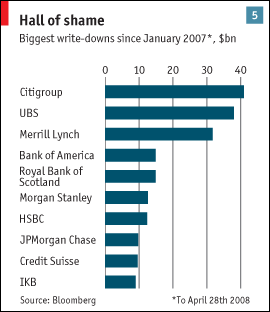
Did you know that readers of this blog had a warning that the world's financial systems were ready to melt down? If you read my July 2007 (one month before the crisis began) post Are the Questions Sound? , you'll remember me disagreeing with a "major Wall Street bank" CISO for calling one of my Three Wise Men (and other security people) "so stupid" for not having the "five digit accuracy" to assess risk. That degree of arrogance was the warning that the financial sector didn't know what they were talking about. The next month I posted Economist on the Peril of Models and then Wall Street Clowns and Their Models in September. Now I read a fascinating follow-up in last week's Economist titled Professionally Gloomy . I found these excerpts striking: [R]isk managers are... aware that they are having to base their decisions on imperfect information. The crisis has underlined not just their importance but also their weaknesses. Take value-a...

FISMA 2007 Scores

Image
The great annual exercise of control-compliant security , the US Federal government 2007 FISMA report card , has been published. Since I've been reporting on this farce since 2003, I don't see a reason to stop doing so now. If you're the sort of sports fan who judges the success of your American football team by the height of the players, their 40-yard dash time, their undergraduate school, and other input metrics, you'll love this report card. If you've got any shred of sanity you'll realize only the scoreboard matters, but unfortunately we don't have a report card on that. Thanks to Brian Krebs for blogging this news item.

Trying Gigamon

Image
I believe I first learned of Gigamon at the 2006 RSA show. I mentioned their appliance 1 1/2 years ago in my post Pervasive Network Awareness via Interop SpyNet . Today I finally got a chance to cable a GigaVUE 422 in my lab. Gigamon describes their appliance as a "data access switch," but I prefer the term "traffic access switch." You can think of the GigaVUE as an advanced appliance for tapping, accepting tap or SPAN output, and filtering, combining, separating, and otherwise manipulating copies of that traffic for monitoring purposes. The device I received contained one fixed panel (far left in the image), plus four configurable daughter cards. This model has fixed fiber ports. At the extreme left of the image you'll see two RJ-45 ports. The top one is a copper network management port, while the lower is a console cable. The first daughter card, to the right of the fixed panel, is a GigaPORT 4 port copper expansion module. That card also has four SF...