Posts

Air Force Enlisted Ratings Remain Dysfunctional

Image
I just read  Firewall 5s are history: Quotas for top ratings announced in Air Force Times. It describes an effort to eliminate the so-called "firewall 5" policy with a new "forced distribution" approach: The Air Force's old enlisted promotion system was heavily criticized by airmen for out-of-control grade inflation that came with its five-point numerical rating system. There were no limits on how many airmen could get the maximum: five out of five points [aka "firewall 5"]. As a result nearly everyone got a 5 rating. As more and more raters gave their airmen 5s on their EPR [ Enlisted Performance Report], the firewall 5 became a common occurrence received by some 90 percent of airmen. And this meant the old EPR was effectively useless at trying to differentiate between levels of performance... Under the new system, [Brig. Gen. Brian Kelly, director of military force management policy] said in a June 12 interview at the Pentagon, the numerica...

Redefining Breach Recovery

Image
For too long, the definition of "breach recovery" has focused on returning information systems to a trustworthy state. The purpose of an incident response operation was to scope the extent of a compromise, remove the intruder if still present, and return the business information systems to pre-breach status. This is completely acceptable from the point of view of the computing architecture. During the last ten years we have witnessed an evolution in thinking about the likelihood of breaches. When I published my first book in 2004, critics complained that my "assumption of breach" paradigm was defeatist and unrealistic. "Of course you could keep intruders out of the network, if you combined the right controls and technology," they claimed. A decade of massive breaches have demonstrated that preventing all intrusions is impossible, given the right combination of adversary skill and persistence, and lack of proper defensive strategy and operations. We n...

My Federal Government Security Crash Program

Image
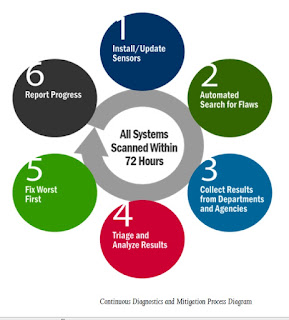
In the wake of recent intrusions into government systems, multiple parties have been asking for my recommended courses of action. In 2007, following public reporting on the 2006 State Department breach, I blogged When FISMA Bites ,  Initial Thoughts on Digital Security Hearing . and What Should the Feds Do . These posts captured my thoughts on the government's response to the State Department intrusion. The situation then mirrors the current one well: outrage over an intrusion affecting government systems, China suspected as the culprit, and questions regarding why the government's approach to security does not seem to be working. Following that breach, the State Department hired a new CISO who pioneered the "continuous monitoring" program, now called "Continuous Diagnostic Monitoring" (CDM). That CISO eventually left State for DHS, and brought CDM to the rest of the Federal government. He is now retired from Federal service, but CDM remains. Years l...

Continuous Diagnostic Monitoring Does Not Detect Hackers

Image
There is a dangerous misconception coloring the digital security debate in the Federal government. During the last week, in the wake of the breach at the Office of Personnel Management (OPM), I have been discussing countermeasures with many parties. Concerned officials, staffers, and media have asked me about the Einstein and  Continuous Diagnostic Monitoring  (CDM) programs. It has become abundantly clear to me that there is a fundamental misunderstanding about the nature of CDM. This post seeks to remedy that problem. The story  Federal cyber protection knocked as outdated, behind schedule by Cory Bennett unfortunately encapsulates the misunderstanding about Einstein and CDM: The main system used by the federal government to protect sensitive data from hacks has been plagued by delays and criticism that it is already outdated — months before it is even fully implemented. The Einstein system is intended to repel cyberattacks like the one revealed last week ...

An Irrelevant Thesis

Image
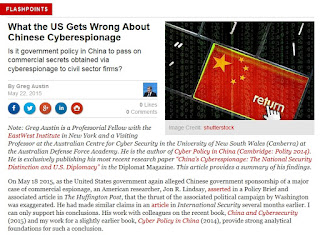
This week The Diplomat published an article by Dr Greg Austin titled  What the US Gets Wrong About Chinese Cyberespionage . The subtitle teases the thesis: "Is it government policy in China to pass on commercial secrets obtained via cyberespionage to civil sector firms?" As you might expect (because it prompted me to write this post), the author's answer is "no." The following contains the argument: "Chinese actors may be particularly adept in certain stages of economic espionage, but it is almost certainly not Chinese government policy to allow the transfer of trade secrets collected by highly classified intelligence sources to its civil sector firms for non-military technologies on a wide-spread basis . A U.S. influencing strategy toward China premised on the claim that this is China’s policy would appear to be ill-advised based on the evidence introduced so far by the United States in the public domain." (emphasis added) I find it interest...

What Year Is This?

Image
I recently read a manuscript discussing computer crime and security. I've typed out several excerpts and published them below. Please read them and try to determine how recently this document was written. The first excerpt discusses the relationship between the computer and the criminal. "The impersonality of the computer and the fact that it symbolizes for so many a system of uncaring power tend not only to incite efforts to strike back at the machine but also to provide certain people with a set of convenient rationalizations for engaging in fraud or embezzlement. The computer lends an ideological cloak for the carrying out of criminal acts. Computer crime... also holds several other attractions for the potential lawbreaker. It provides intellectual challenge -- a form of breaking and entering in which the burglar’s tools are essentially an understanding of the logical structure of and logical flaws inherent in particular programming and processing systems. It opens ...

The Need for Test Data

Image
Last week at the RSA Conference, I spoke to several vendors about their challenges offering products and services in the security arena. One mentioned a problem I had not heard before, but which made sense to me. The same topic will likely resonate with security researchers, academics, and developers. The vendor said that his company needed access to large amounts of realistic computing evidence to test and refine their product and service. For example, if a vendor develops software that inspects network traffic, it's important to have realistic network traffic on hand. The same is true of software that works on the endpoint, or on application logs. Nothing in the lab is quite the same as what one finds in the wild. If vendors create products that work well in the lab but fail in production, no one wins. The same is true for those who conduct research, either as coders or academics. When I asked vendors about their challenges, I was looking for issues that might meet the cr...